Category Archives: Bird Behavior

City Owl Learns to Fly

Eurasian eagle-owl closeup (photo from Wikimedia Commons)
16 July 2025

Eurasian eagle owls (Bubo bubo) span the continent from Norway and Spain to the Russian Far East, the Koreas, and China. Because they have been persecuted by people they are very sensitive to human disturbance in Sweden and will abandon eggs and even nestlings.

In some places they nest in parks, such as this owl family in southern Germany.

(video from Wikimedia Commons)
But the most amazing were the city owls who moved into Helsinki about 20 years ago when the rabbit population grew large. One of them became famous by “crashing” a soccer playoff at Helsinki Olympic Stadium(*).

A wild Eurasian eagle-owl, “Bubi,” flies at Helsinki Olympic Stadium, 6 June 2007 (photo from Wikimedia Commons)

Another pair nested above a city street in 2011. One of their youngsters miscalculated a short airborne hop and his mistake became an adventure. He had his first city tour complete with a fire department rescue from the top of the “Southern Fried Chicken” sign.

Watch as the city eagle owl learns to fly.

video embedded from Eagleowl 321 on YouTube

Eurasian eagle owls are not reported anymore in Helsinki’s city center. I suspect that they left when the rabbit population returned to normal.

p.s. More about the celebrity owl at the stadium: On 6 June 2007 the Euro 2008 Finland-vs-Belgium qualifying match was being held at the stadium when an eagle owl landed on the field and flew to the goal posts. The game was suspended during the owl’s visit while the crowd cheered “Huuhkaja!” (Finnish common name for the owl). Finland won the game 2-0, the owl was nicknamed Bubi and “Helsinki Citizen of the Year,” and  Finland’s soccer team was nicknamed the “Eurasian Eagle Owls.” See a video of Bubi’s game-time visit here

Canada Geese on the Road

Canada goose family on the road in California, June 2023 (photo from Wikimedia Commons)
11 July 2025

It’s that time of year again when Canada geese are on road. For about a month the adults are flightless as they molt their wing feathers and their goslings cannot fly either so the families walk everywhere, even on the road.

In Shaler Township 100 Canada geese have been paying no attention to traffic when they cross Route 8, as shown in this 8 July 2025 video from KDKA

video embedded from CBS NEWS Pittsburgh on YouTube

This is a pretty harsh environment for geese so why are they here instead of somewhere else?

Canada geese on the road in Shaler (screenshot from embedded video by CBSNEWS Pittsburgh)

Flightless geese need two important things within walking distance during their month of ground operations: a safe place to sleep on water and food during the day.

As the video points out, people are feeding the geese so that need is covered. As for water notice how Pine Creek(*) is just a short step away from the parking lots. They sleep at Pine Creek, eat at the shopping centers.

Everything a flightless goose could want: Water and food (screenshot from Google maps)

This also explains why they abandon Flagstaff Hill — a favorite feeding spot — during the breeding season. There’s not water within walking distance.

Find out more about their flightless month in this article from 2023.

(*) p.s. I corrected the Pine Creek map at 5:30pm per Scott G’s comment. Google Maps plain view shows a loop in Pine Creek that was removed 25 years ago. I altered the image to match Google’s Satellite map.

.

.

.

Danger! Hawk!

American robin making a high-pitched alarm call in Prospect Park, NYC (photo from Wikimedia Commons)

10 July 2025

Birdsong is coming to an end as the breeding season wraps up but birds are still making contact and warning calls. In a recent walk in Frick Park Charity Kheshgi pointed out a robin saying “Danger from the air!” a sound so high-pitched that I no longer hear it.

Upper frequency sounds are hard to pinpoint so a robin saying “Danger! Hawk!” should be hard for the hawk to find … except that robins making this warning call usually stand out in the open, as the shown above.

Learn to identify robin and starling warning calls in this vintage article. Unlike birdsong these sounds happen all year long.

.

.

.

Making the World Safe for Young Ravens

Raven harassing a red-tailed hawk in California (photo from Wikimedia Commons)

27 June 2025

Ravens are omnivores whose varied diet includes roadkill, rodents, grasshoppers and the nestlings of smaller birds. Since ravens are the largest “songbird” all the smaller birds mob ravens. Ravens in turn mob hawks.

Watch how adult ravens keep the world safe for their youngsters in this video by Vance Crofoot.

video embedded from Exploring Wildlife with Vance Crofoot on YouTube

p.s. Ravens also attack bald eagles. This photo is from Orcas Island, Washington. I’ve seen the same thing at Hays Woods.

Raven harassing a bald eagle (photo from Wikimedia Commons)

Yellow Crashes the Party at Pitt Peregrine Nestbox

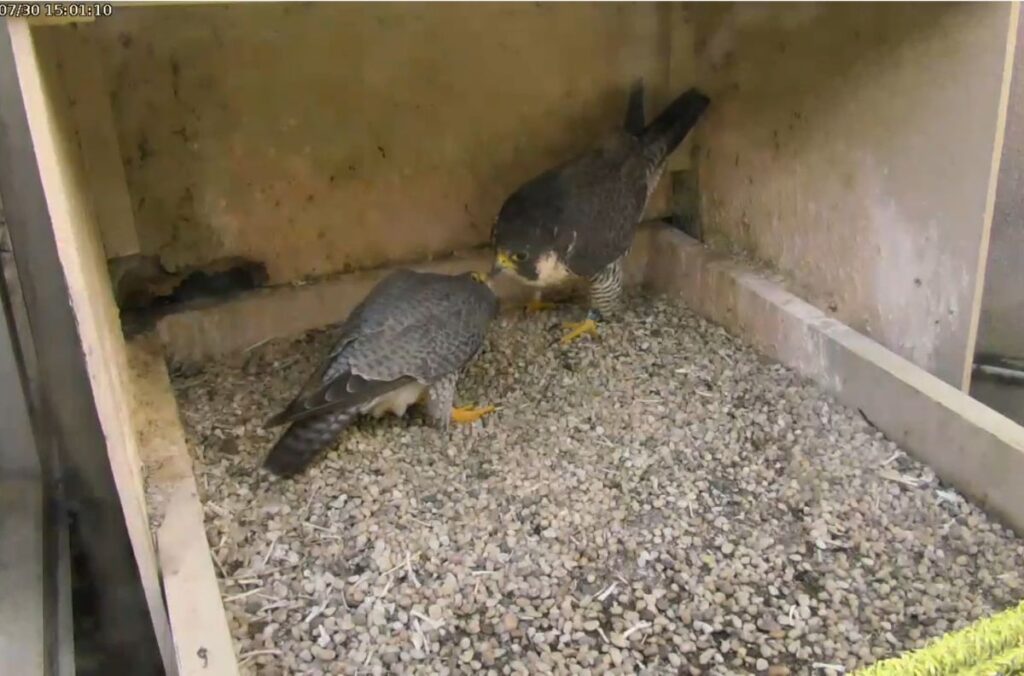
Yellow crashed in on her mother. Carla left quickly. 23 June 2025 (photo from the National Aviary snapshot camera at Univ of Pittsburgh)

25 June 2025

On Monday afternoon, 23 June, Carla and Ecco bowed at the nest then Carla was preening when her daughter “Yellow” crashed in. Carla left so quickly that the snapshot didn’t capture it.

Yellow had nothing else to do so she hung out in the heat.

(photos from the National Aviary snapshot camera at Univ of Pittsburgh)

It seems like the “kids” ought to be ready to leave home but they typically don’t depart until mid July. It’s going to be a long couple of weeks for Carla and Ecco.

Avoiding The Kids

Ecco and Carla strengthen their pair bond, 19 June 2025, 11:54am (photo from the National Aviary falconcam at Univ of Pittsburgh)

21 June 2025

After this year’s Pitt peregrine youngsters learned to fly, they stayed away from the nestbox as if to say “That’s the babies’ crib and we aren’t babies anymore.” Instead they perfected their flight skills and relentlessly pursued their parents for food. The nestbox became a peaceful zone where Ecco and Carla could renew their pair bond and avoid their demanding “kids.”

Ecco and Carla bow renew their pair bond, 20 June 2025, 12:10pm (photo from the National Aviary falconcam at Univ of Pittsburgh)

All of that changed yesterday when their daughters invaded the nestbox. Blue barged in while her parents were bowing at 1:30pm and scattered them like ninepins. In a few minutes Yellow joined her.

video embedded from the National Aviary falconcam at Univ of Pittsburgh)

The juvies stayed for 45 minutes while their parents avoided them. Ecco and Carla did not return until almost 3:00pm. I’m surprised they came back on the same day.

Cool Facts About Catbirds

Gray catbird, May 2012 (photo by Shawn Collins)

18 June 2025

We tend to take gray catbirds for granted but here are some cool facts you might not know. For instance:

  • Gray catbirds (Dumetella carolinensis) are monotypic, the only species in their genus. The catbird’s genus name Dumetella means “small thorny thicket” a reference to his habit of singing from inside thorny thickets instead of from a prominent perch.
Gray catbird (photo from Wikimedia Commons)
  • Males and females look alike except for these subtle differences.

Sexes show similar appearances in all plumages, although females average duller than males and average less-extensive rufous on longest undertail coverts.

Birds of the World: Gray Catbird appearance
  • Catbirds use their sense of smell to find their way on migration(!) as described in this vintage article: Sniffing Their Way North.
  • They are present all year in some parts of the U.S. (purple areas below) but most of us see them only in the breeding season. In Pittsburgh they typically arrive in late April and leave in mid October.
Range map of gray catbird from Wikimedia Commons
  • They nest in the middle of thickets and lay turquoise blue eggs.
Cowbird nest with an egg (photo from Wikimedia Commons)
  • Catbirds are rarely parasitized by brown-headed cowbirds because they recognize cowbird eggs in their nests and kick them out. Note the color! described in this vintage article Cat Versus Cow.
Catbird (blue) and cowbird (speckled) eggs (photo by Chuck Tague)
  • Male catbirds are jazzmen! Their song is an improvisation rather than a direct imitation. Read more at: Virtuoso

Here’s the catbird’s song:

Gray catbird song (recording by Michael Hurben, Xeno Canto #925322)

(video from Wikimedia Commons)

And here’s his “meow.”

Gray catbird meow-ing (Xeno Canto 819785)

Enjoy his song this month. He’ll stop singing soon.

Peregrine Update Southwest PA, 11 June

Three pre-fledglings at Westinghouse Bridge, 8 June 2025 (photo by Dana Nesiti)

11 June 2025

By now most peregrine sites in southwestern Pennsylvania have fledged or are in progress. At East Liberty Presbyterian steeple the youngsters will fly next week. Here’s the news from the most active sites.

Cathedral of Learning, Univ of Pittsburgh

The young Pitt peregrines are really hard to find now. The best viewing I’d had in a few days was on Monday 9 June when I found 2 adults and 1 juvenile. Later a second juvenile flew off the Cathedral of Learning (CL) toward UPMC, circled back, and landed on the CL. Obviously they are flying so well that I cannot find them anymore. Except …

Yesterday Blue Girl surprised Ecco at the nest so she stuck around hoping he’d return with food. No chance. She bopped around in the nestbox pretending she was learning to fly. “I don’t wanna grow up!”

photos from the National Aviary snapshot cam at Univ of Pittsburgh

East Liberty Presbyterian Church, Pittsburgh
Peregrine chick looks out of the nest, East Liberty Presbyterian steeple, 7 June 2025 (photo by Adam Knoerzer)

The young peregrines at East Liberty Presbyterian steeple may be a week away from flying. Adam Knoerzer’s photos above and below were taken four days ago when the chicks were already exercising their wings.

Peregrine chick exercising its wings, East Liberty Presbyterian steeple, 7 June 2025 (photo by Adam Knoerzer)

Yesterday, 10 June, they were lying flat but looked browner than on 7 June. The edge of the nest reveals an unhatched egg.

Peregrine chicks lying flat plus unhatched egg, East Liberty Presbyterian steeple, 7 June 2025 (photo by Adam Knoerzer)

Stay tuned for news as they fledge.

Sewickley Bridge, Ohio River

Gene Henderson has been visiting the Sewickley Bridge frequently in the past week and has watched the youngsters progress. From in the nestbox to ledge walking to fledged and begging. Gene expects they will be flying so well in the next day or two that he won’t be able to find them.

On 3 June before they left the box.

On 10 June, ledge walking …

… and whining from the top of the bridge, “I flew, now feed me!”

Westinghouse Bridge, Turtle Creek near Monongahela River

Dana Nesiti stopped by the Westinghouse Bridge on Sunday and saw three youngsters. By now they’ve probably fledged. Dana’s video is 15 minutes long.

SUMMARY FOR SOUTHWEST PA

Southwestern Pennsylvania peregrine sites are listed in the table below. Help fill in the blanks below by visiting a site near you. Leave a comment if you find anything!

Pitt Peregrine Progress: Flying and Whining

2 sisters: Pitt peregrine fledglings Blue and Yellow hang out and whine on 15South at the Cathedral of Learning, 7 June 2025 (photos by Kate St. John)

8 June 2025

My husband walked over to the Cathedral of Learning (CL) yesterday and texted me before he went indoors, “Just arrived at CL. I hear lots of begging peregrine babies!” I was preparing to drive home from Frick so I detoured to Pitt and stepped out to look.

I got lucky. The young peregrines would have been impossible to find on their third or fourth day of flying but they were noisy.

  • The two sisters Yellow and Blue were whining on the 15th floor roof ledge facing Forbes Avenue. Slideshow above.
  • Carla was perched above them on 28th floor southeast (28SE) stone peak, inaccessible to begging youngsters.
  • GreenBoy flew around the top of the building with lots of flappy flight and settled at 38 southeast (38SE) roof ledge watching the sky for his father, Ecco.
  • Ecco flew by to check on the “kids” but he didn’t stop (no photo). More whining!
Carla at 28SE, 7 June 2025 (digiscoped by Kate St. John)
Green Boy at 38SE roof ledge, 7 June 2025 (digiscoped by Kate St. John)

In half an hour of watching yesterday I saw the entire peregrine family!

If you stop by the Cathedral of Learning in the next several days check out these tips for finding the young peregrines: Fledge Watch Tips: Have They Flown? And Where?

Eventually they will perch on other buildings but when they are on the CL they typically perch at the floors marked in this photo taken from the sidewalk in front of Phipps Conservatory.

Cathedral of Learning as seen from Phipps sidewalk (photo from Wikimedia Commons)

All 3 Pitt Peregrines Have Flown

Peregrine juvenile, probably Blue, at 38SW under the (offline) CL Tourcam (photo by Kate St. John)

6 June 2025

When we arrived yesterday for Fledge Watch at Schenley Plaza, we could tell that all three juveniles had flown(*). None were visible on the camera or nestrail and though I walked around the Cathedral of Learning looking for fledglings, none were visible anywhere. It was hot.

At noon we noticed a juvenile silently perched in the shade under the CL tourcam. It was Blue Girl. I saw her blue tape through my scope. She preened and sometimes opened her wings, a motion that says, “Here I am, parents, in case you want to bring food.” If she was really hungry she would have whined.

Peregrine juvenile grooming at 38SW (photo by Kate St. John)
Peregrine juvenile, probably Blue, at 38SW under the (offline) CL Tourcam, 5 June 2025 (photo by Kate St. John)

A few minutes later we saw Carla feeding a juvenile on the opposite corner at 38SE.

Carla feeding a juvenile at 38SW, 5 June 2025 (photo by Kate St. John)

Now that the juvenile peregrines are hard to find, Fledge Watch is over.

(*) My guess on when they flew: One or two probably fledged on the afternoon of 4 June and the remainder yesterday morning 5 June.