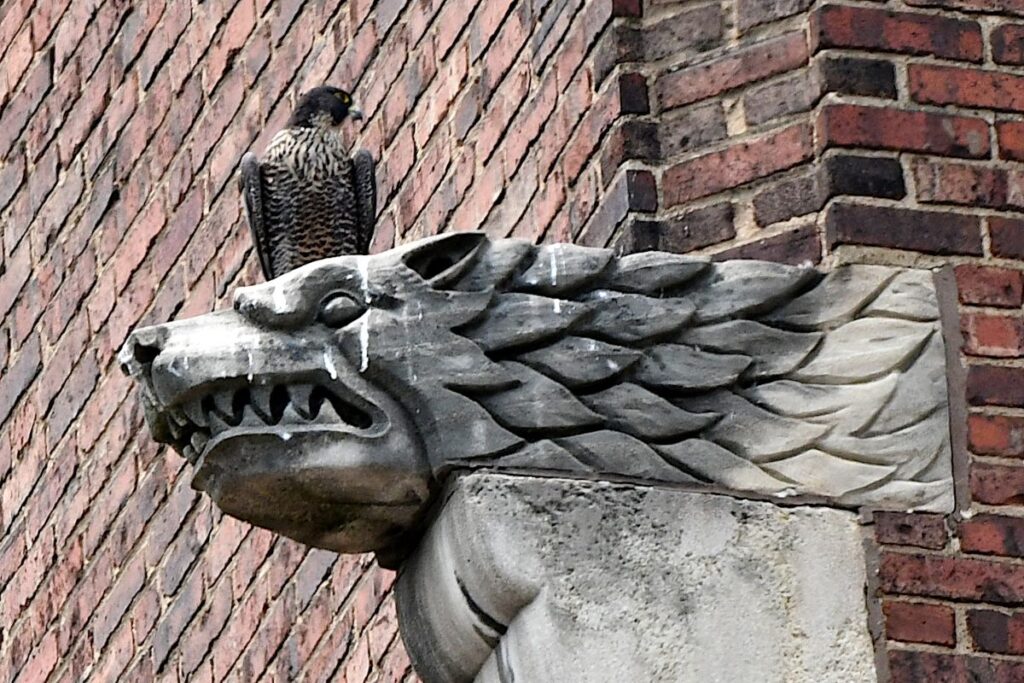
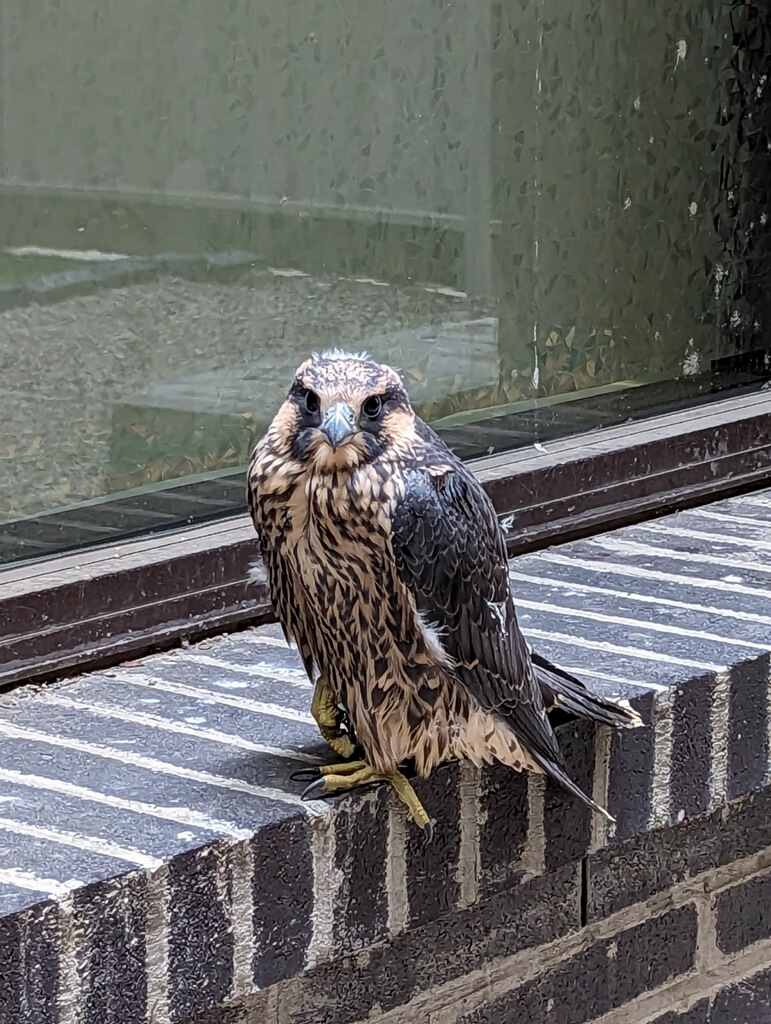
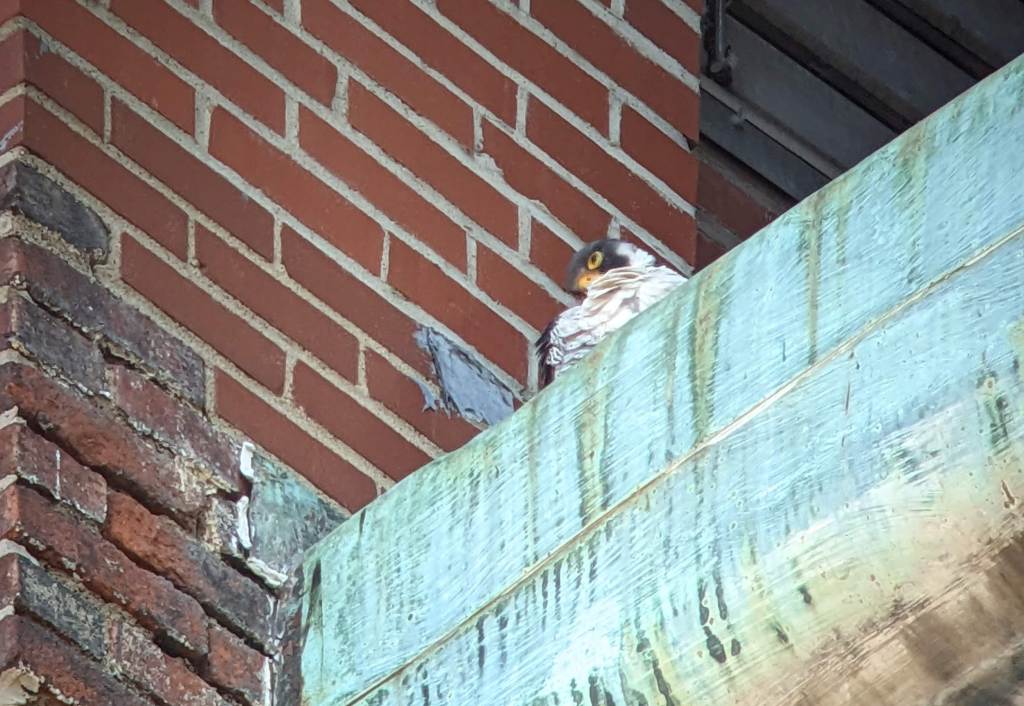
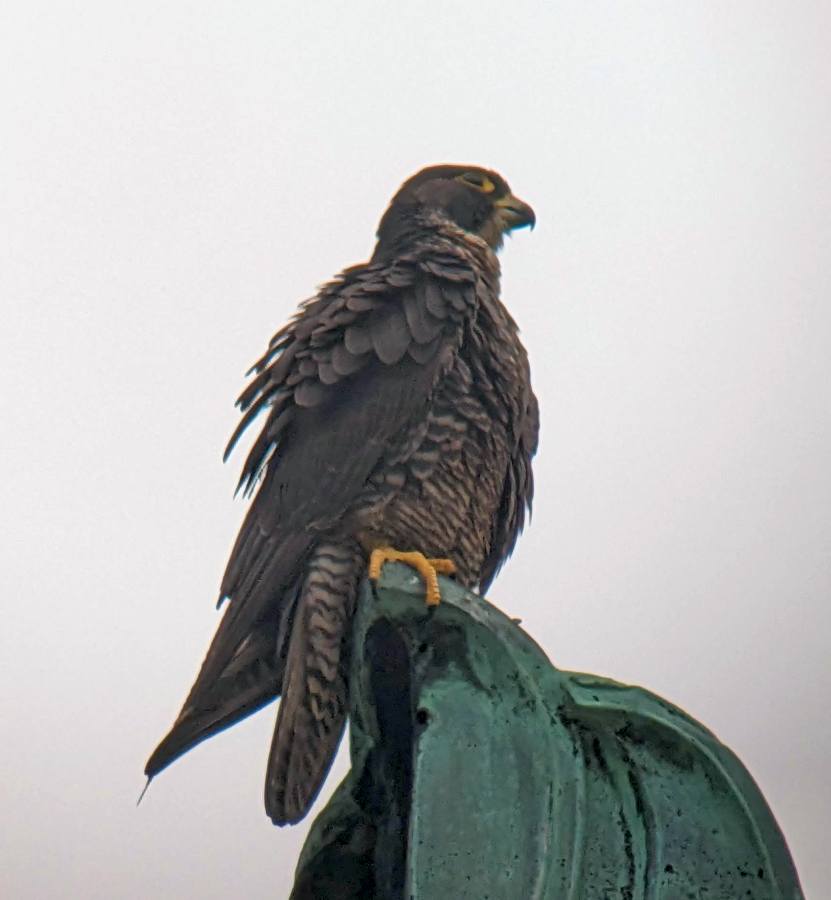
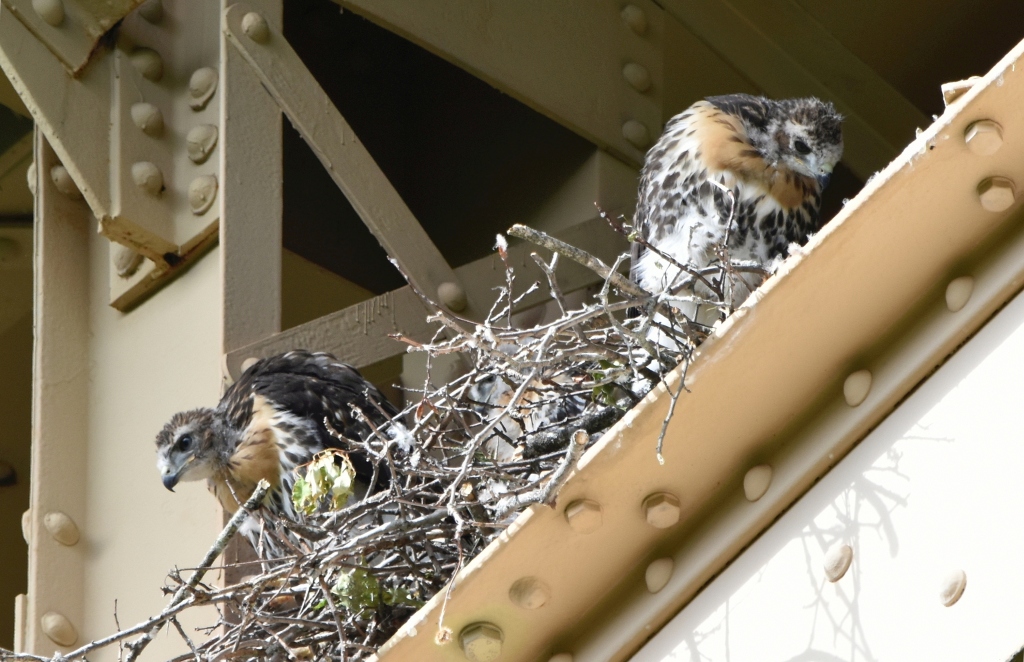
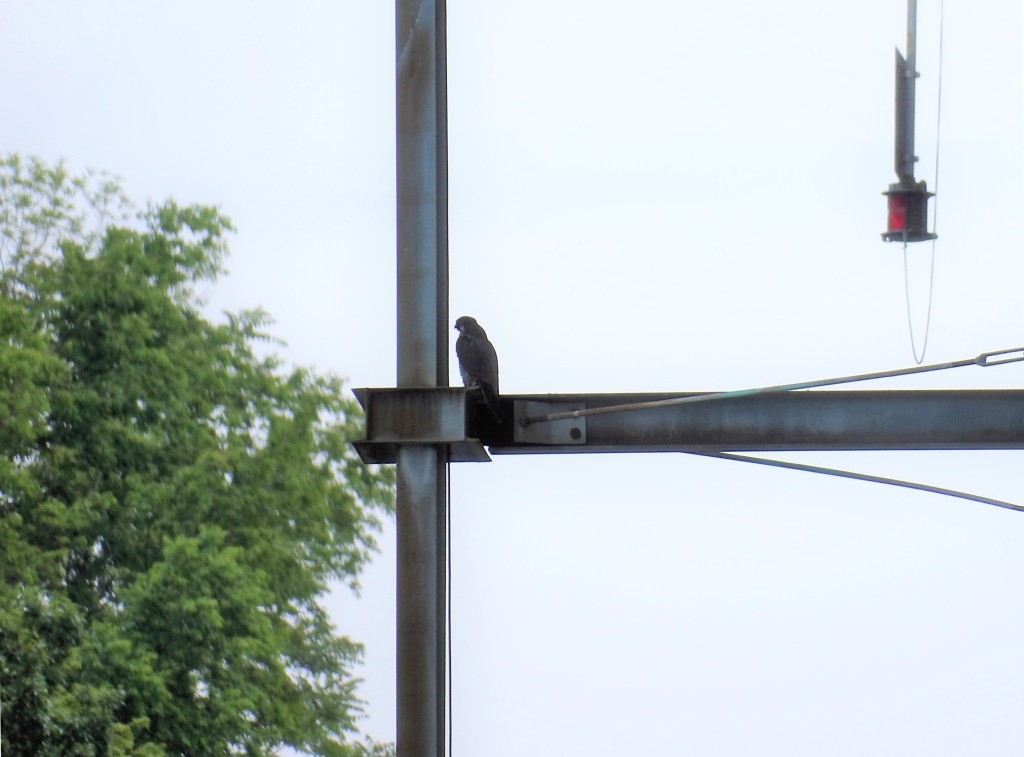
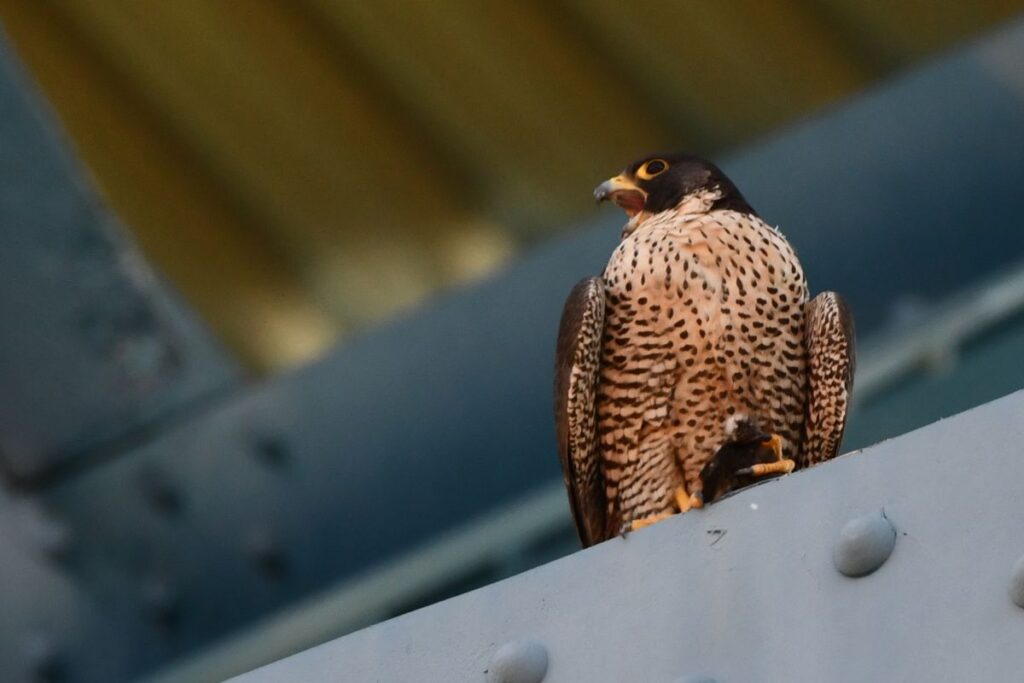
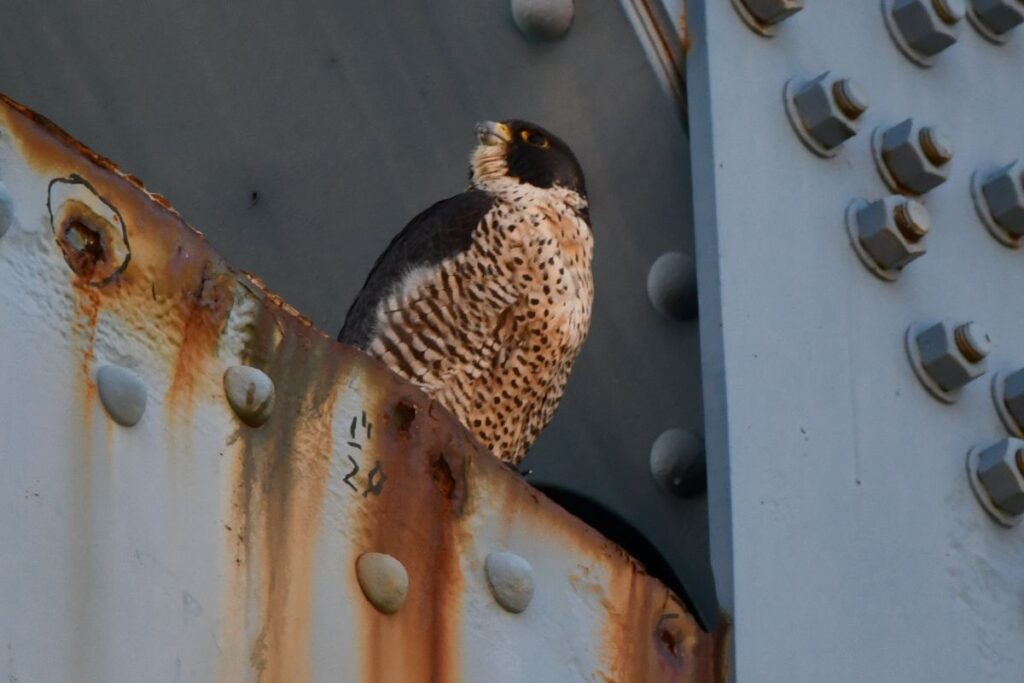
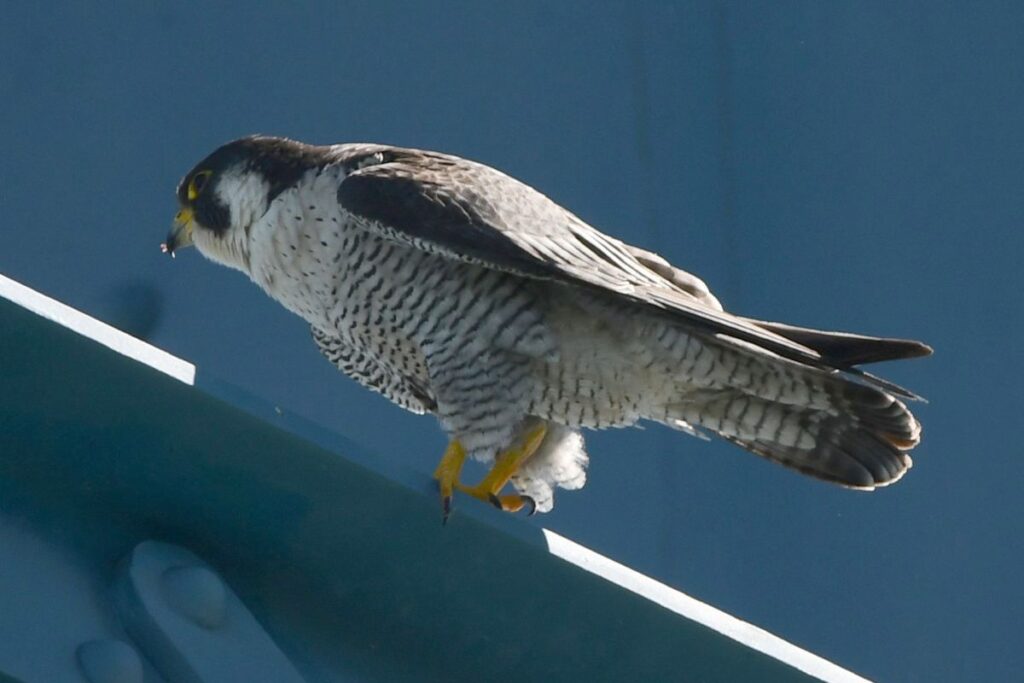
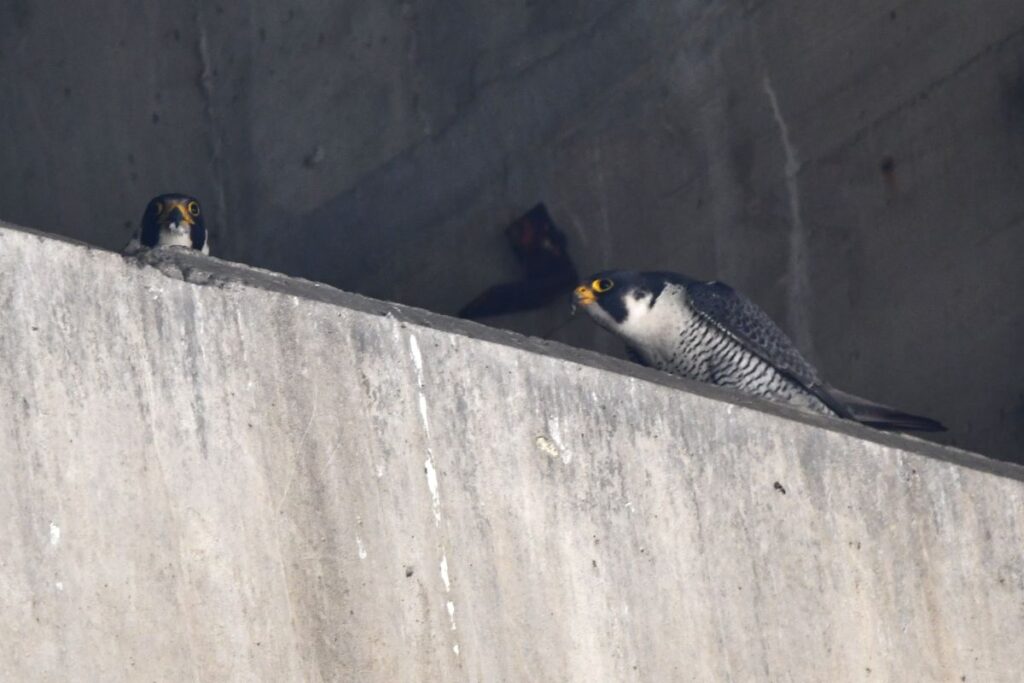
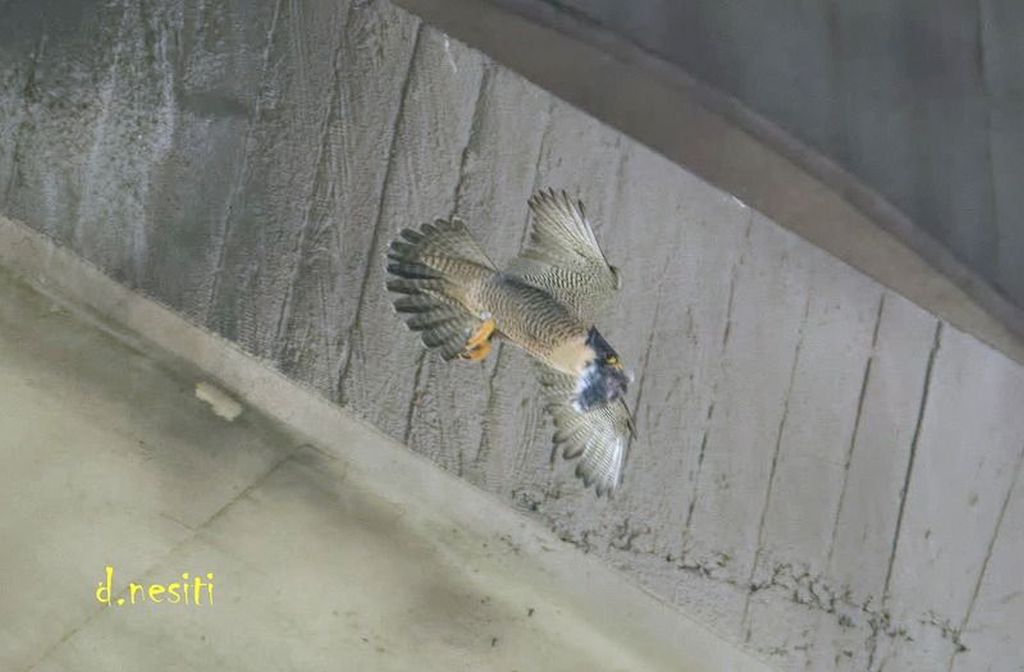
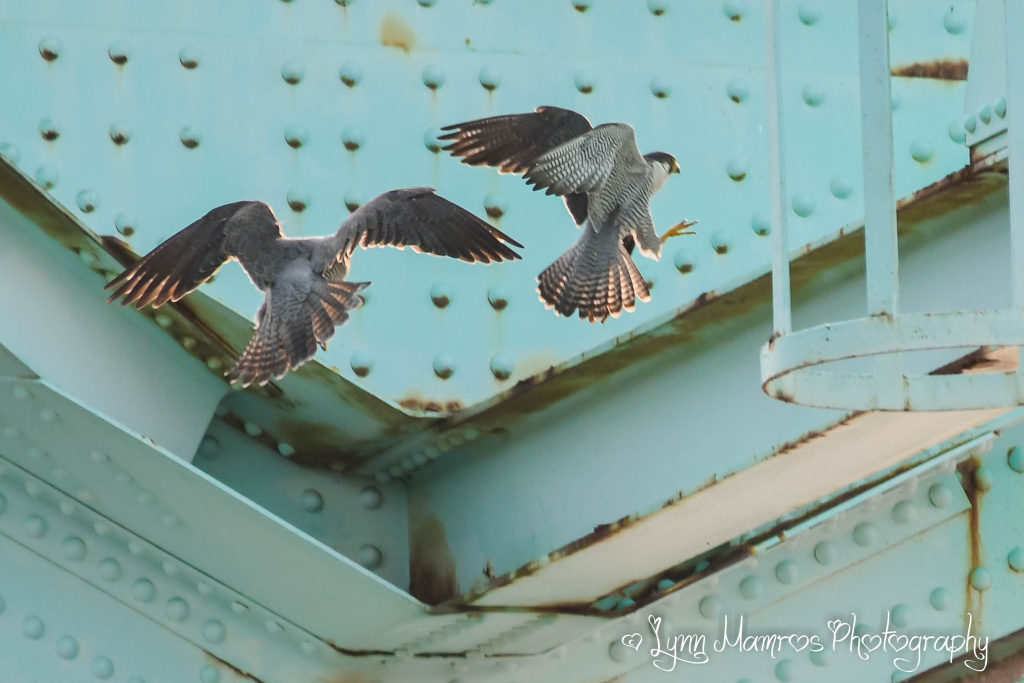
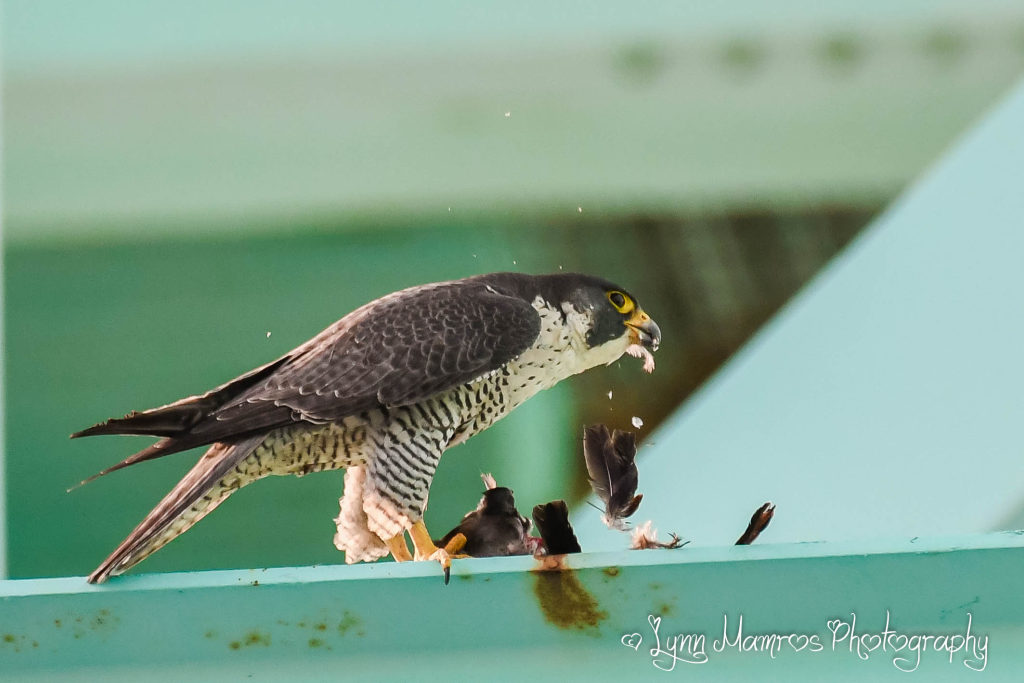
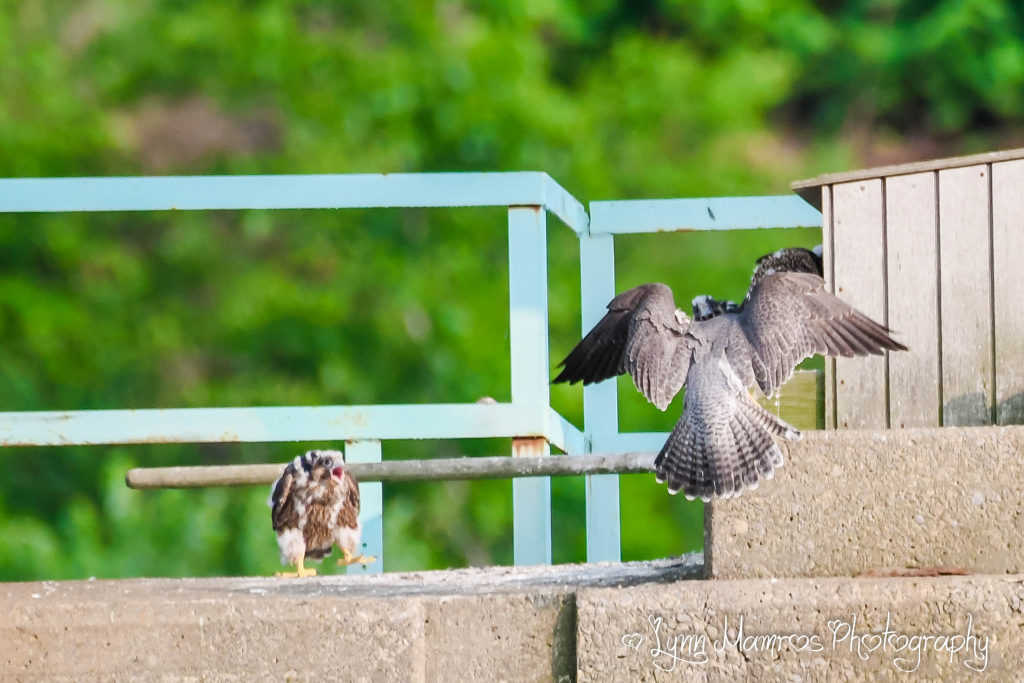
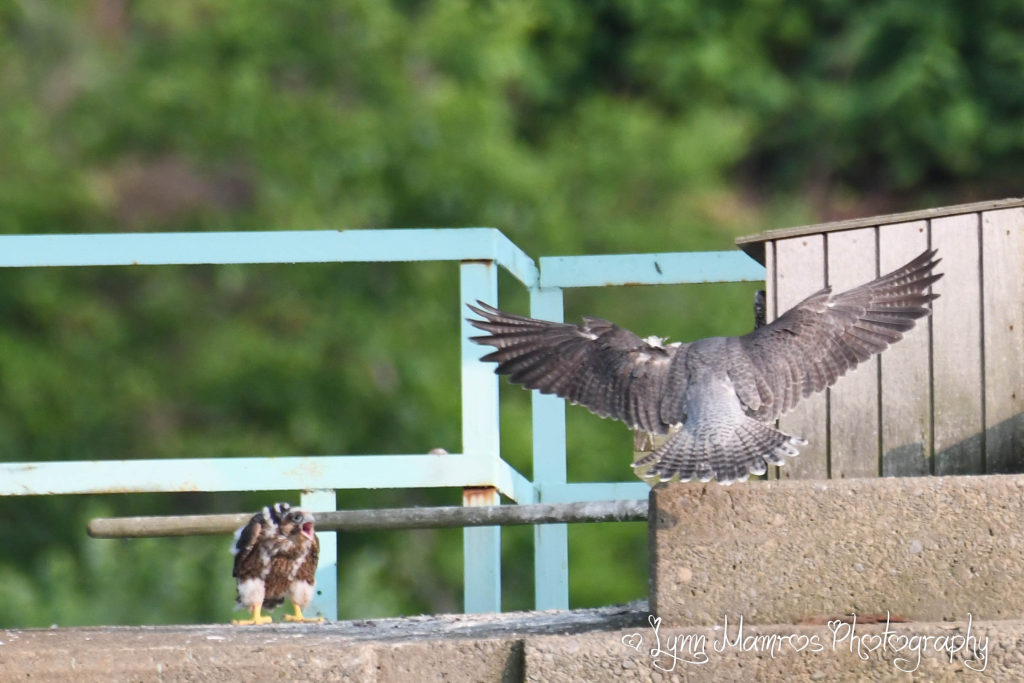
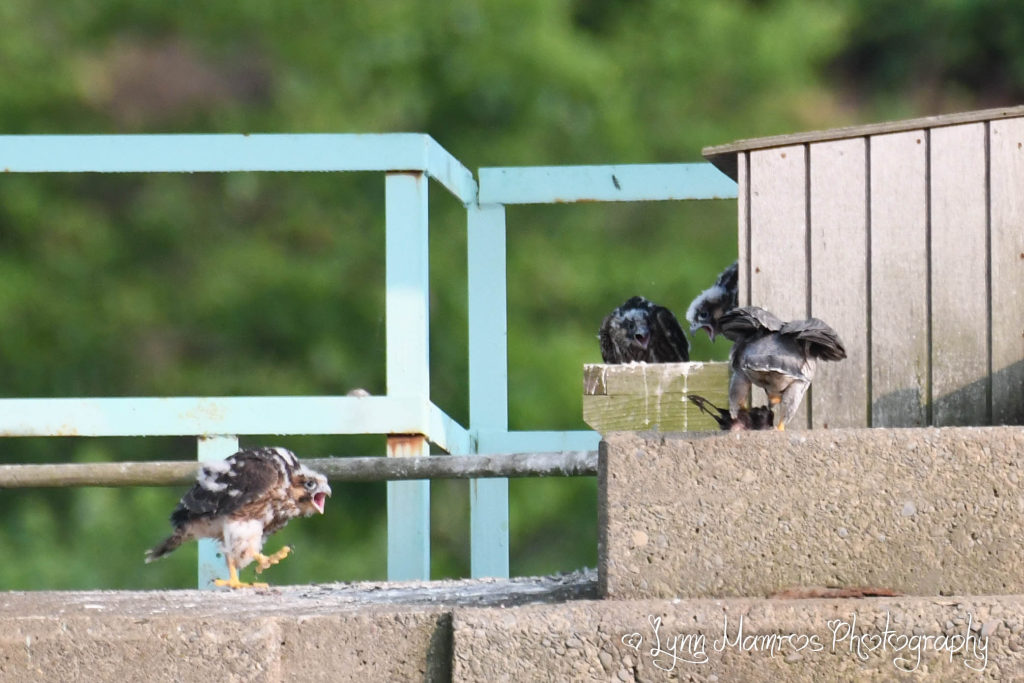
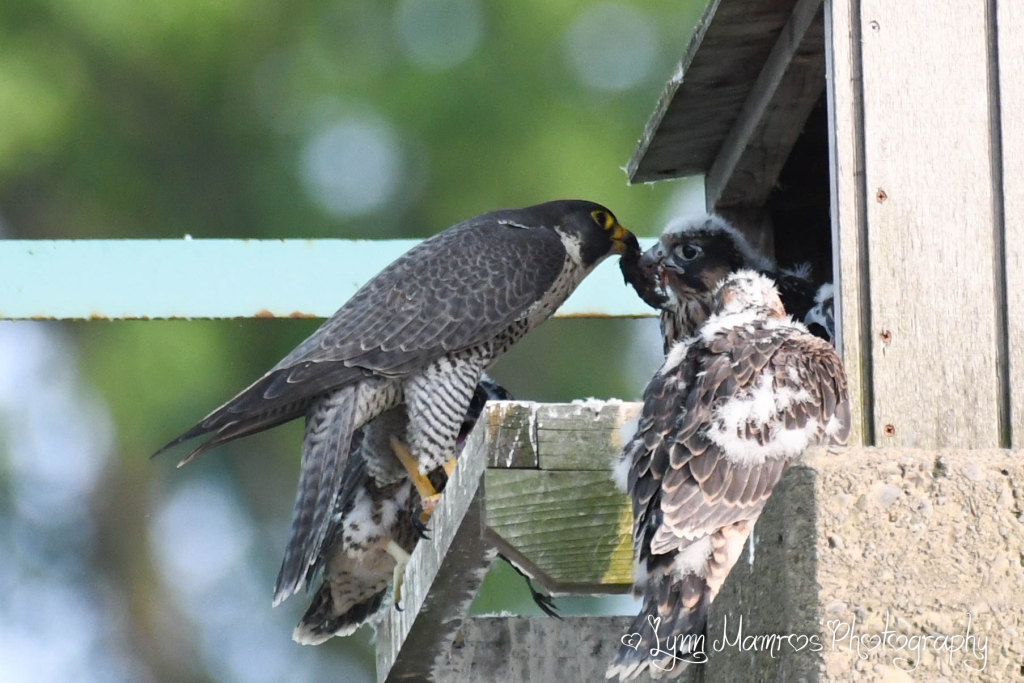
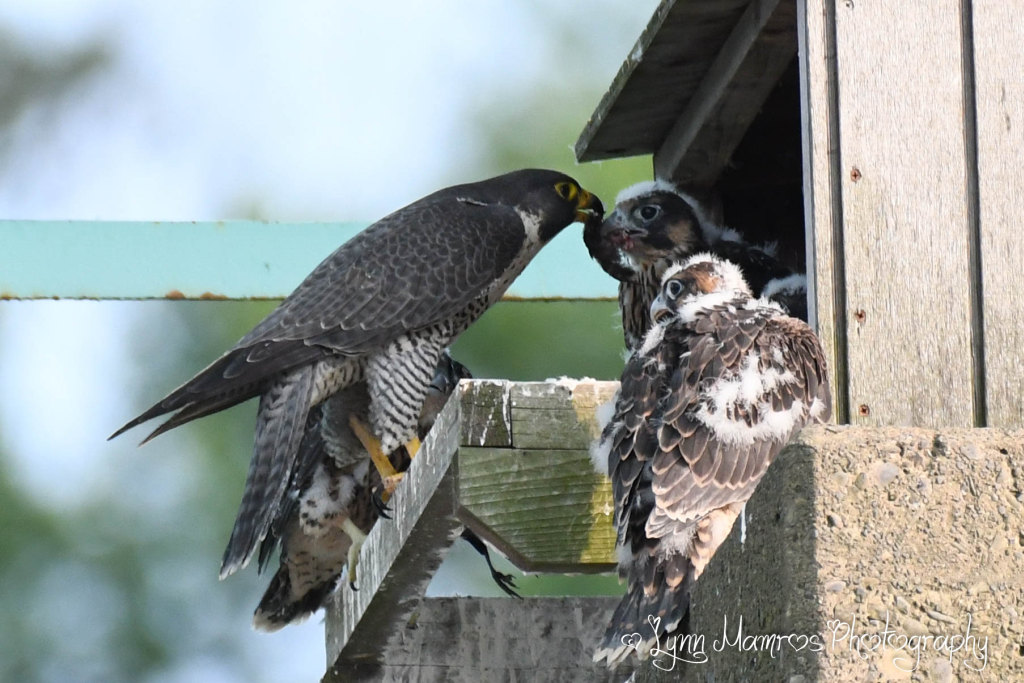
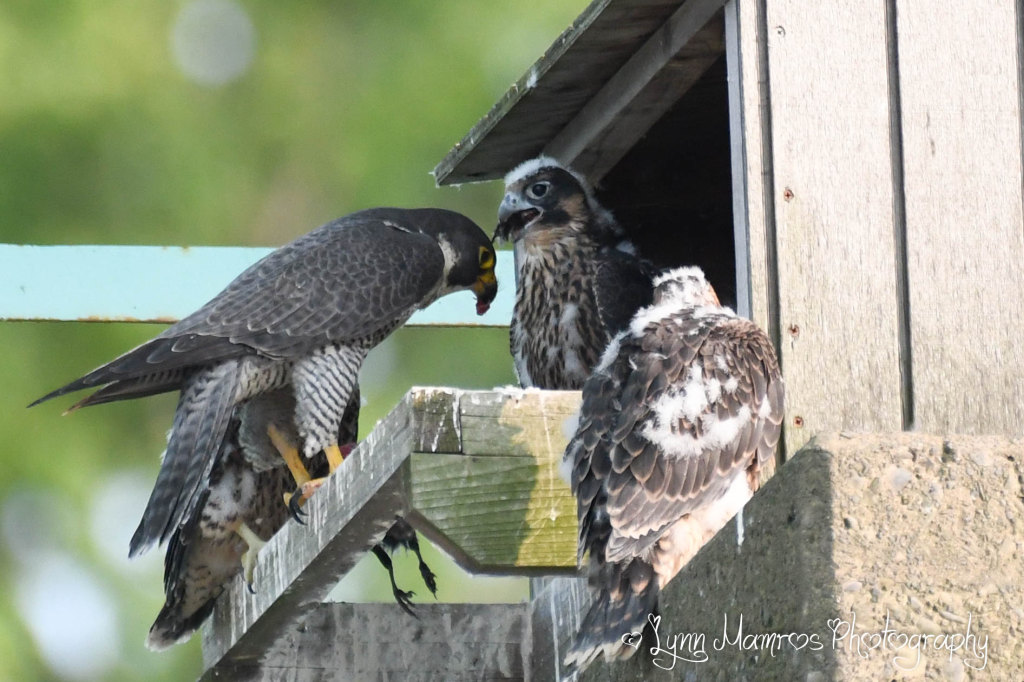
Because the Pitt peregrines had no eggs this year I miss seeing their young on camera. To fill that gap I’ve been following the Fulham and Barnes Peregrines at Charing Cross Hospital in London, UK whose daily lives are chronicled by @FaBPeregrines.
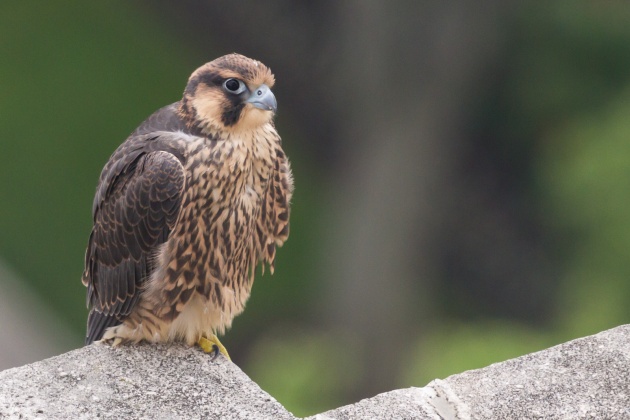
Azina, Tom and their son P6T (named for his band number) are frequently seen on camera, even in late August. P6T’s dispersal from his natal site is on a later schedule than we’re used to in Pittsburgh.
Juvenile peregrines in Pittsburgh fledge in early June and leave in July. At Fulham and Barnes, P6T fledged in the fourth week of May and is still hanging around in late August. His persistence gives us an opportunity to watch a peregrine family in late summer when the youngster hunts on his own.
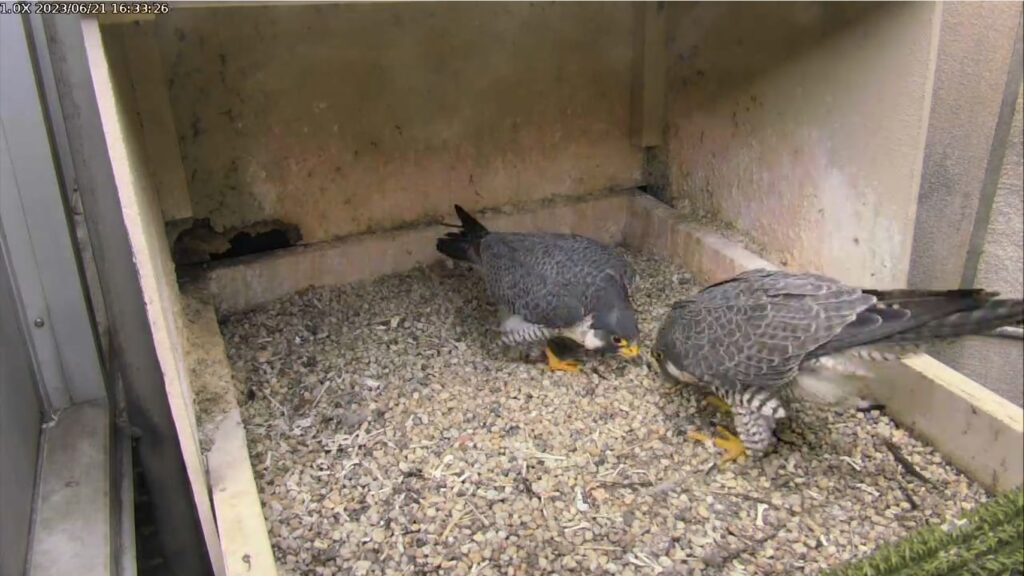
The whole family on the ledge for a very brief moment when Tom comes and snatches P6T's prey while P6T is busy annoying his mum 😉 (P6T had brought in that pigeon not long before that and eaten only part of it) pic.twitter.com/Srvl55fNIb
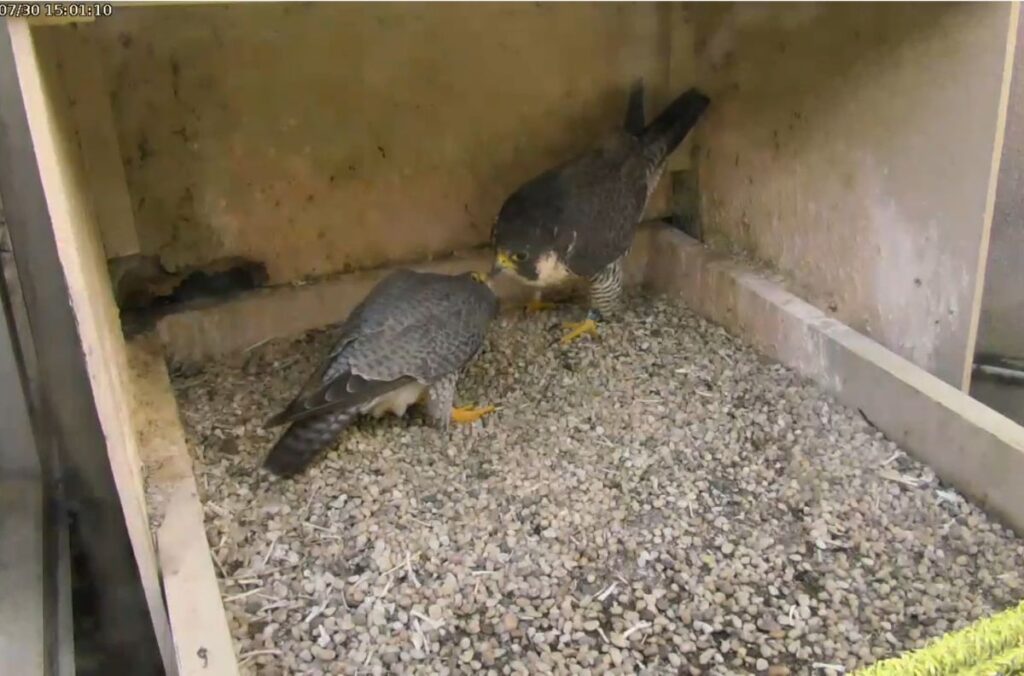
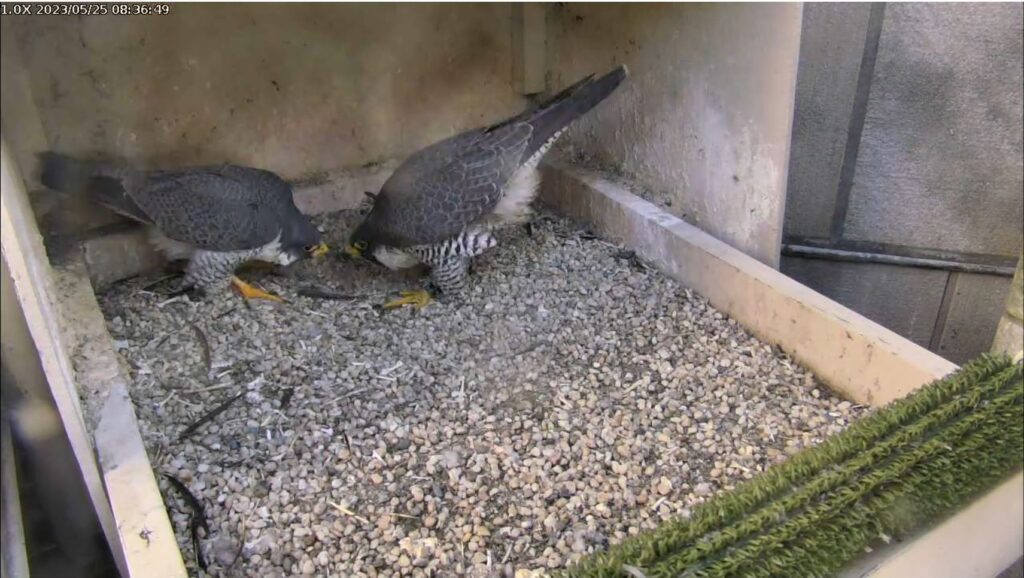
Each year the National Aviary falconcam at the Cathedral of Learning runs from February through July to cover the peregrine breeding season. Streaming ended on 31 July but just the day before, on 30 July, Ecco and Carla bowed for a long time at the nest and Carla occasionally ate some gravel. (*more information on gravel below)
The entire bowing session lasted 8 minutes but they paused a lot so I sped up the video to double-time. At 3 minutes in, it looks as if Carla has left but she’s merely off camera. As she comes close again Ecco resumes e-chupping and bowing. Finally Carla flies away and Ecco stands up straight to watch her leave.
Though the bowing looks like courtship they won’t be starting a family anytime soon. Ecco and Carla live at the Cathedral of Learning all year long and bow to strengthen their pair bond, even in July.
The pair is generally less active in the summer but they’ll perk up when fall migration begins in earnest as they watch birds flying south over Oakland.
This morning just after dawn I saw a peregrine fly by my window carrying prey to the Cathedral of Learning. I’m sure it was Ecco bringing breakfast to Carla. The pair is “in tune” as if it was nesting season. Ecco supplies Carla’s food and they bow at the nest several times a day, but I know there will be no eggs at the Cathedral of Learning this year. It’s too late to raise a peregrine family.
Today on Throwback Thursday I looked back seven years to find that the blog was All Peregrines All The Time in 2016. In this trip down memory lane, you might remember a few of these incidents from that June.
A moment of repose: Peregrine fledgling C1, 16 June 2016 (photo by Peter Bell)
One week later a banded female peregrine showed up on camera at the Cathedral of Learning nest. It was Magnum from the Neville Island I-79 Bridge territory where she had already fledged two young. (Click here or on the video screenshot for the story.)
A few days later Magnum left Oakland, Hope and Terzo paired again, and their fledgling grew up and left town.
This year, by contrast, is very quiet. Fingers crossed for a good season next year.
Dark brown female at Third Avenue Downtown, perched on Lawrence Hall, 5 June 2023 (photo by Jeff Cieslak)
11 June 2023
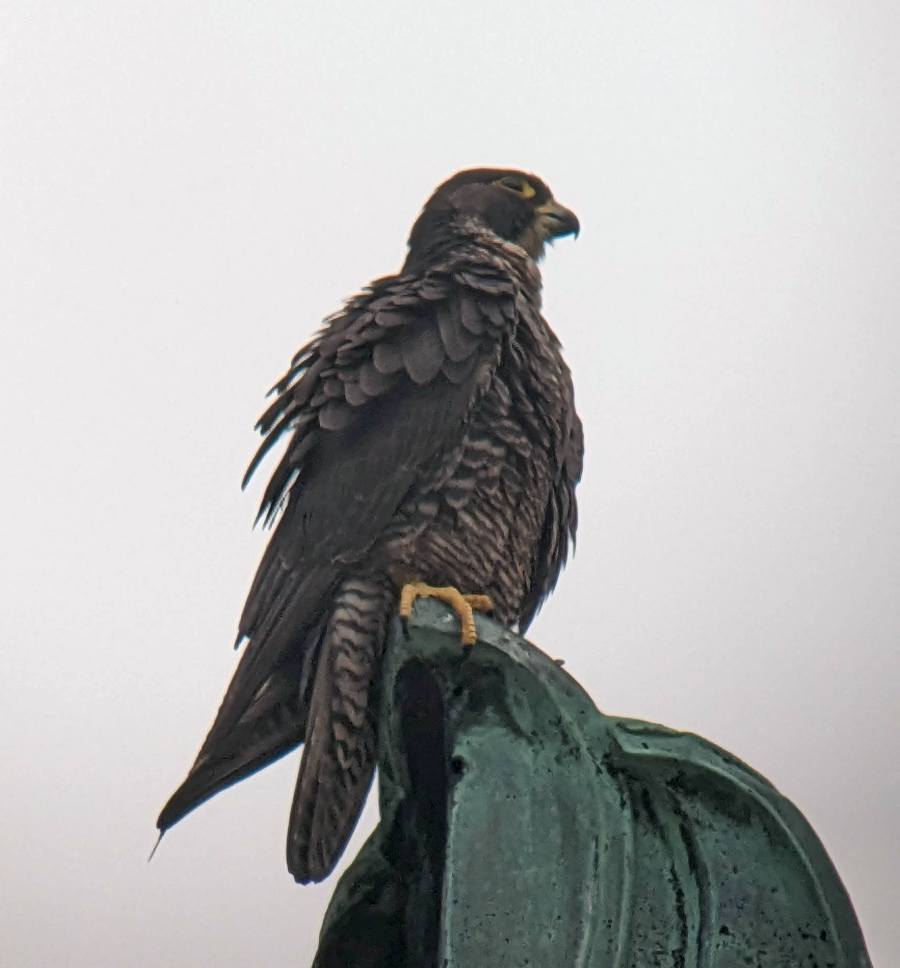
This spring Downtown Pittsburgh’s peregrines were so confusing that for two months we weren’t even sure of their age and sex. By now we know that the male at Third Avenue is Terzo and the dark brown bird is female. Why is this bird so dark? The mystery is intriguing.
Wrong ID for the dark bird: In early April Jeff Cieslak and I were both convinced the dark brown bird was a one-year-old male because we saw it enter the Third Avenue nest carrying prey even though the eggs had not hatched yet. After all, male peregrines bring prey to incubating females and immature birds have brown plumage … don’t they?
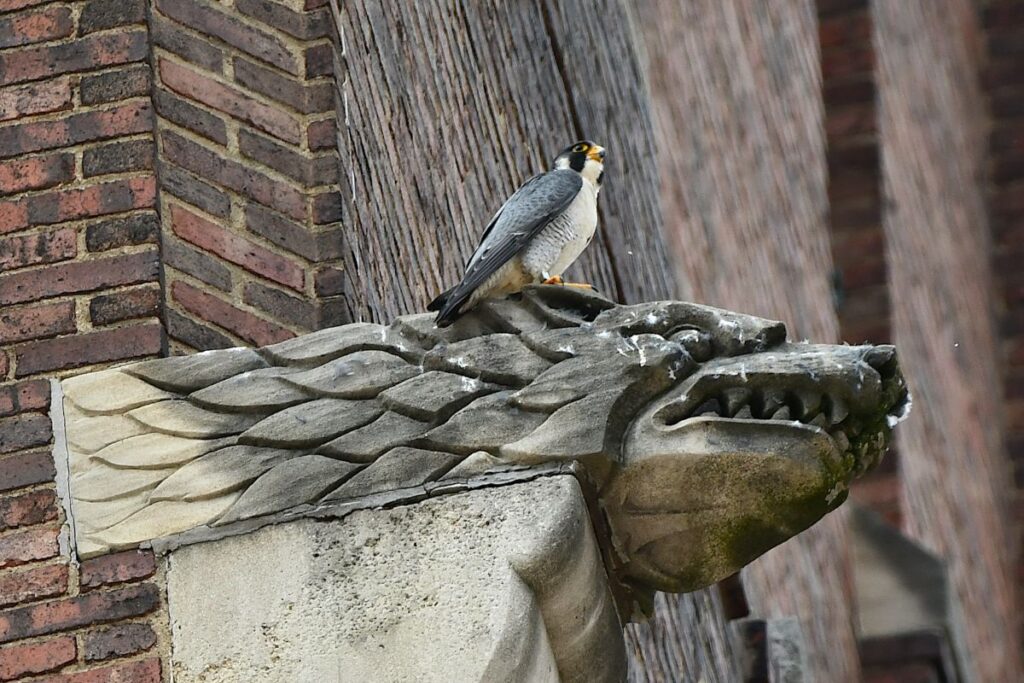
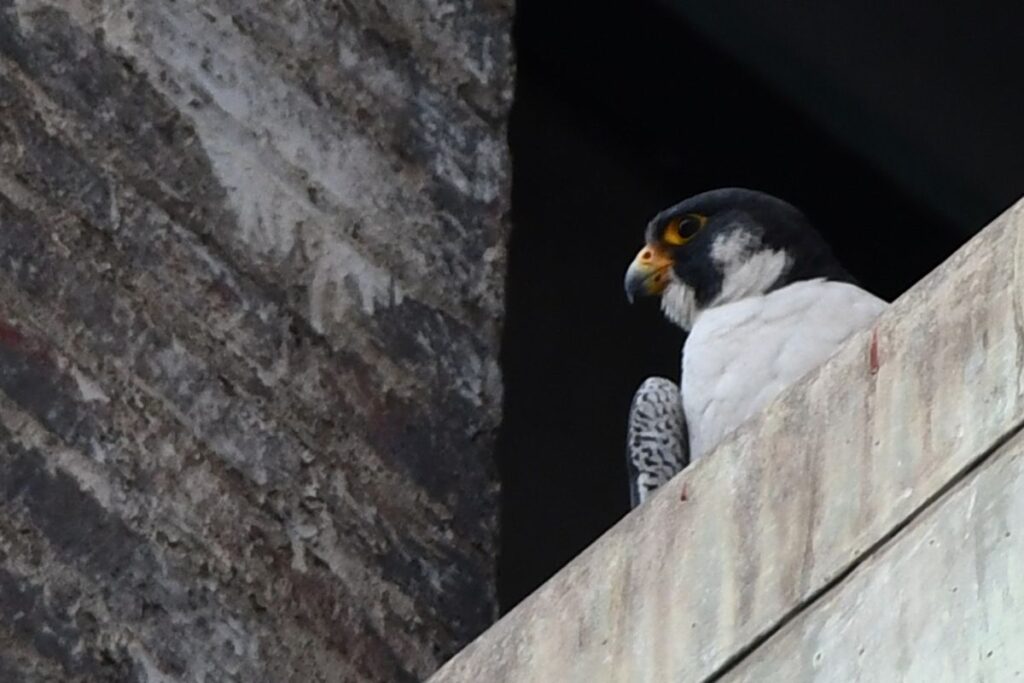
Solve the easy ID first: Who is the banded white-chested bird? Jeff Cieslak’s April and May photos show that the gray-and-white adult has black/red bands. Also, several viewers remarked that the bird’s face is like Terzo in other photos. This bird is the male, Terzo.
Terzo at Third Avenue Downtown perched on Lawrence Hall, 5 June 2023 (photo by Jeff Cieslak)
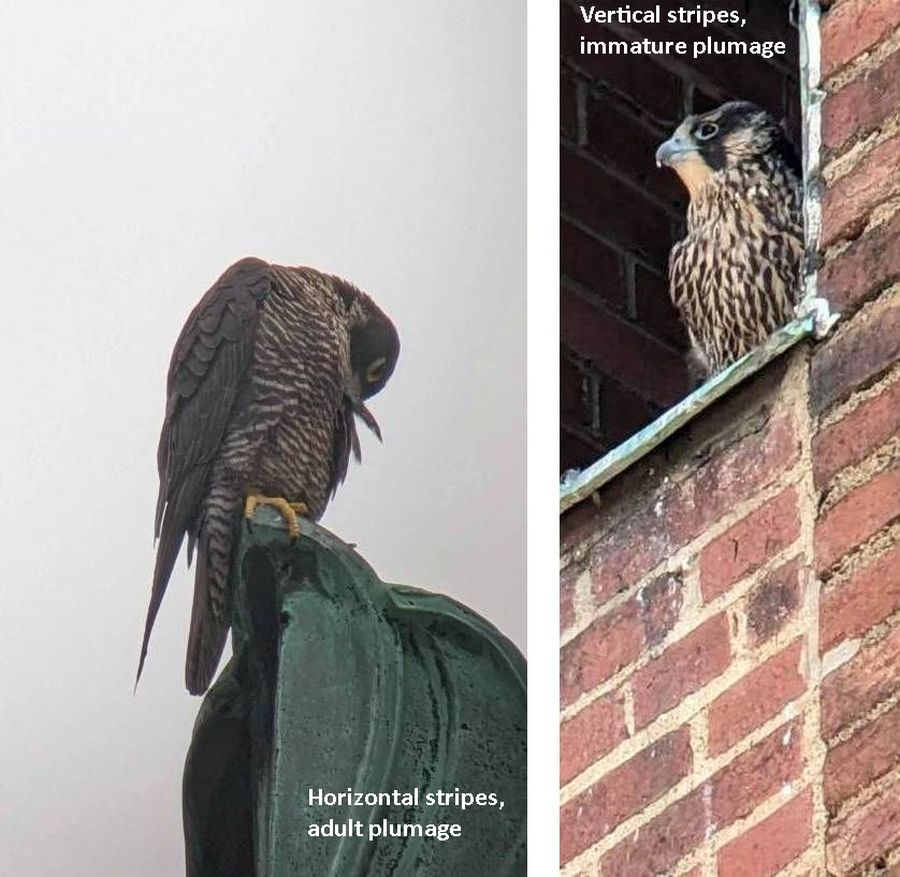
Is the dark bird immature? No. Adult plumage has horizontal stripes on the flanks and belly, immature plumage has vertical stripes. Compare these side-by-side adult and juvenile peregrines photographed at Third Avenue.
Comparing peregrine adult vs juvenile plumage: Adult plumage has horizontal stripes, juvie plumage has vertical stripes (photos digiscoped by Kate St. John)
Is the female completely dark brown? No. This photo of her back shows it is grayer in color than her belly.
Dark brown female is grayer on her back, 3 June 2023 (photo by Kate St. John)
Why is this bird so dark? I sent photos to Art McMorris, retired PA Game Commission Peregrine Coordinator, and asked: “This adult at the Third Ave nest site Downtown is very brown and not banded as far as we can see. It doesn’t have juvenile vertical stripes on flanks and chest. I don’t know what to make of this coloration.”
Art’s reply includes a Peregrine Reintroduction discussion in the third paragraph:
This is indeed a very puzzling-looking bird. I’m looking at these 3 photos and the photo Jeff Cieslak took on 4/14. All show the horizontal banding typical of adult peregrines, not juveniles. But it is very brown, atypical of adults. It is much grayer in the third photo you sent; nowhere near as brown but still very dark.
Structurally, it looks like a typical peregrine to me.
Taking all of this together, I’d say it is reminiscent of pealei [Pacific Northwest subspecies]. Pealei is non-migratory, so I wouldn’t suggest that it might be a bird from the Pacific Northwest, but pealei is also one of the 7 subspecies used for captive breeding and release. And occasionally genetic recombination in the wild population results in birds with unusual coloration. I know of 2 cases of peregrines that looked exactly like pure tundrius, but their parents had the typical appearance of the re-introduced population, which strongly resembles eastern anatum (but is not anatum; it’s an intergrade of the 7 subspecies). One of those tundrius look-alikes was from the Gulf Tower, quite a few years ago when the population was still small.
So, my best guess is that this bird is an adult peregrine in which recombination has resulted in homozygosity of some alleles from its pealei ancestors. And the downtown bird is fertile, inconsistent with it being any kind of hybrid.
It will be interesting to see what this year’s young look like when they molt into adult plumage. But unfortunately, we’ll never know.
— Paraphrased email from Art McMorris, 4 June 2023
What other clues do we have about this bird? Art has so much experience with peregrines that he also said: “Earlier the brown bird was called the male, but the feet look female to me.”
Yo! Big feet?!
Dark adult peregrine at Third Avenue, 28 May 2023 (photo digiscoped by Kate St. John)
Just when I think I’ve got it all figured out, peregrines surprise me again.
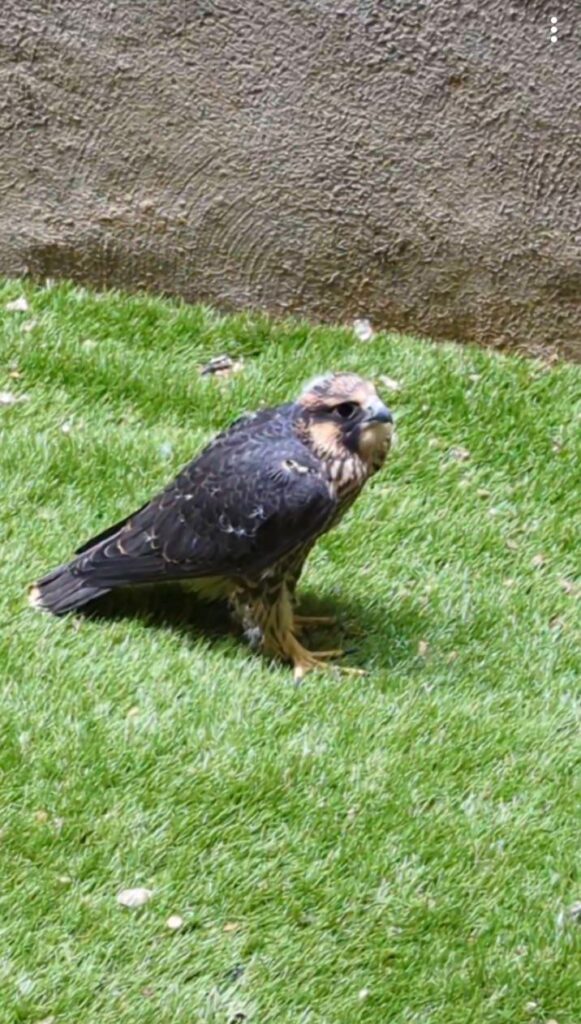
Fledgling peregrine on the dog park windowsill (only 2 feet up), 5 June 2023 (photo by Leslie Mcilroy via Mark Catalano)
7 June 2023
At 6:30pm on Monday 6 June, Mark Catalano of Wildlife In Need Emergency Response was working dispatch in Central PA, making phone calls and sending texts and emails on behalf of a juvenile peregrine in a tiny dog park in Downtown Pittsburgh. The juvie needed assistance to be placed up high to start over on his first flight. Meanwhile Leslie McIlroy was in the dog park, protecting the bird from the visiting dogs.
Fledgling peregrine at the dog park on Third Avenue, 5 June 2023 (photo by Leslie Mcilroy via Mark Catalano)
Mark called the PA Game Commission but he knew it would be a long wait for a Game Warden. Since Mark is from Northumberland, PA he didn’t know any local peregrine contacts so he asked his wife to search the Internet for “Pittsburgh peregrine.” She found me, Mark sent me photos, and I told him about the Rescue Porch.
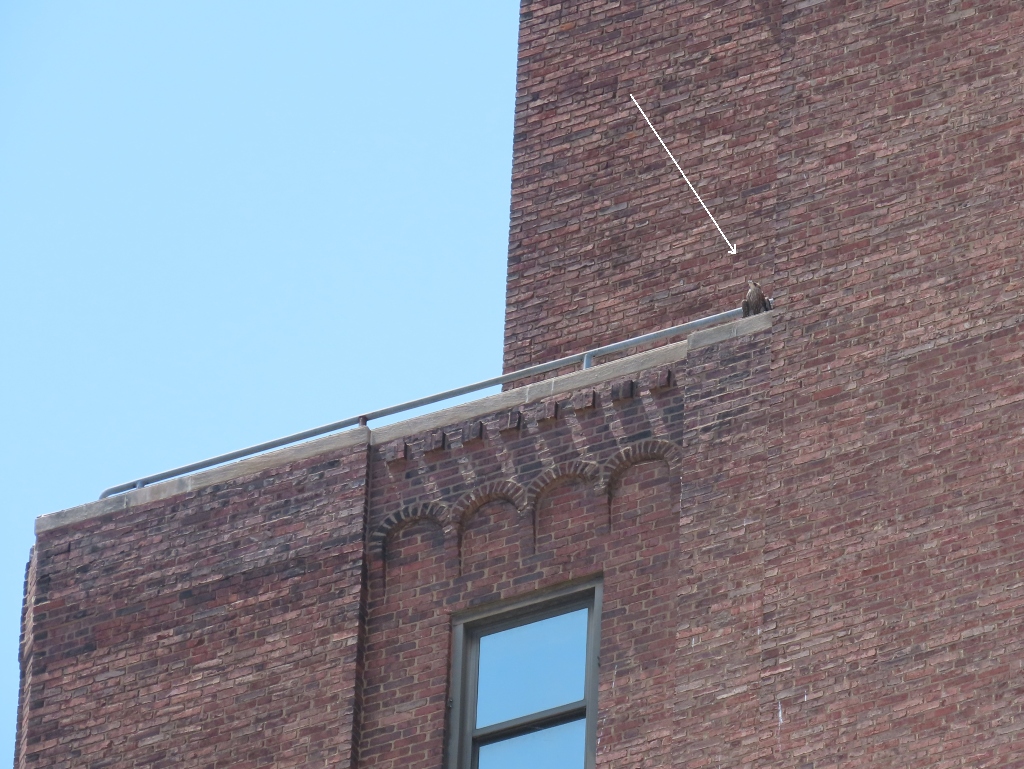
The Rescue Porch is a high balcony across the street at Point Park University’s Lawrence Hall. Another juvie had already tried it out this week, as seen by Diane Walkowski and Lori Maggio at 1:30pm on Sunday 4 June. (White arrow points to the bird.)
Juvenile peregrine calls from the Rescue Porch at Third Avenue, 4 June 2023, 1:50pm (photo by Lori Maggio)
Monday’s bird was stuck in a place I’d never heard of. It turns out that this narrow space under construction in 2021 became a tiny dog park with a tiny patch of grass. The yellow arrow points to a 2021 juvie who eventually landed in here. This year’s juvie hopped up to the low windowsill on the righthand wall, only two feet off the ground (photo at top).
Future dog park under construction on Third Ave, June 2021 (photo by Kate St. John)
Many thanks to Mark Catalano for starting the rescue and to Leslie McIlroy for guarding the bird until the Game Warden arrived three hours later.
Meanwhile, no news is good news. Sunday’s bird is out and about. Monday’s bird probably flew on Tuesday. Will the third youngster need a rescue too? Time will tell.
Peregrine falcons have nested in Downtown Pittsburgh since 1991 and though the players have changed they are very loyal to the territory. From 1991-2011 they nested at the Gulf Tower but since 2012, with three exceptions, they have nested at the back of a building facing Third Avenue. 2023 is their ninth nesting season at this site.
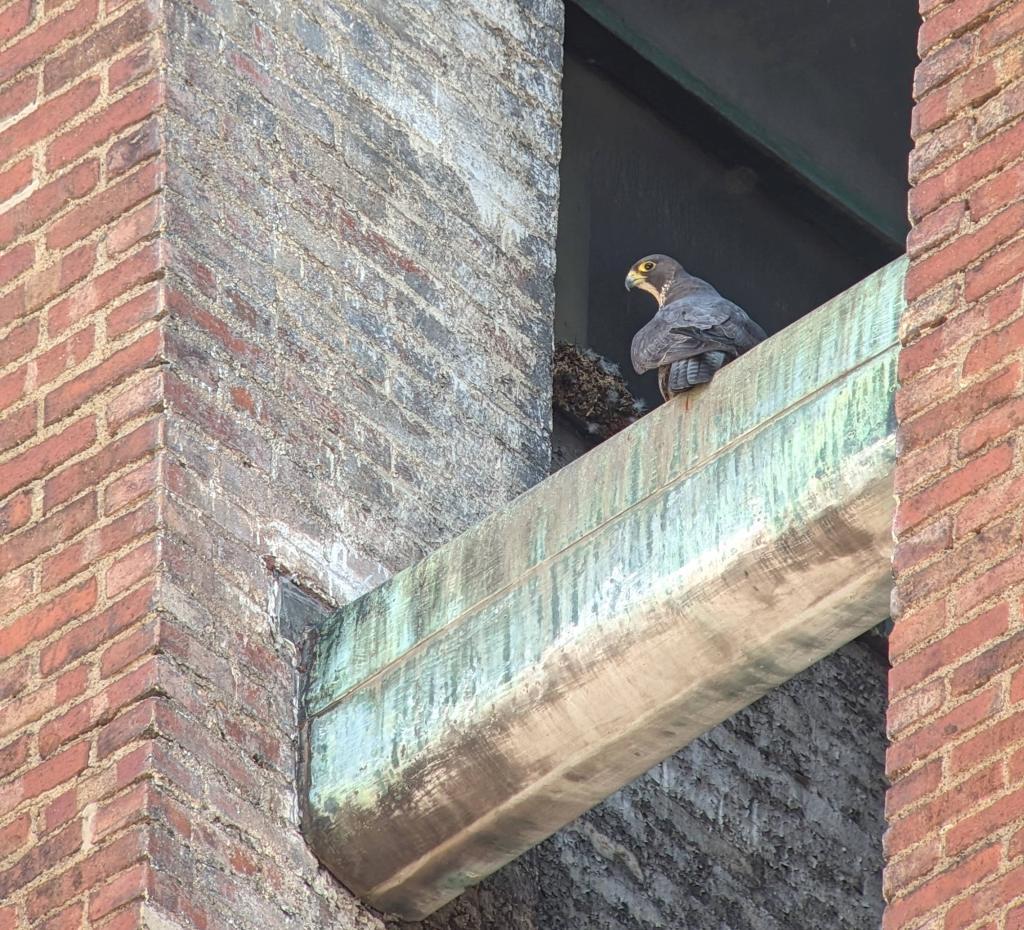
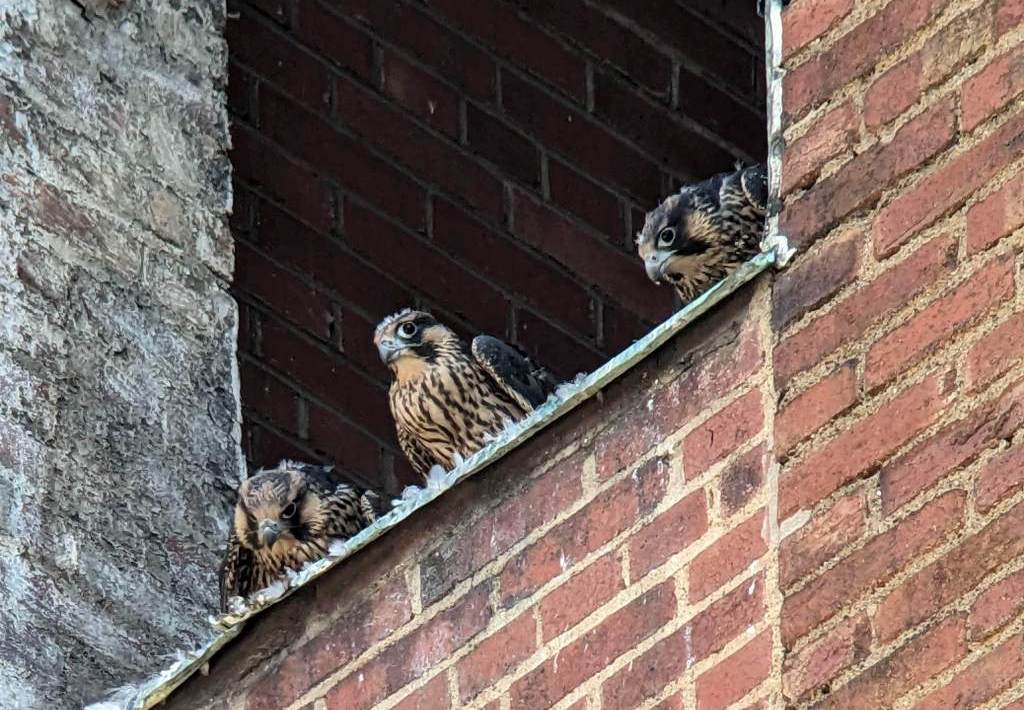
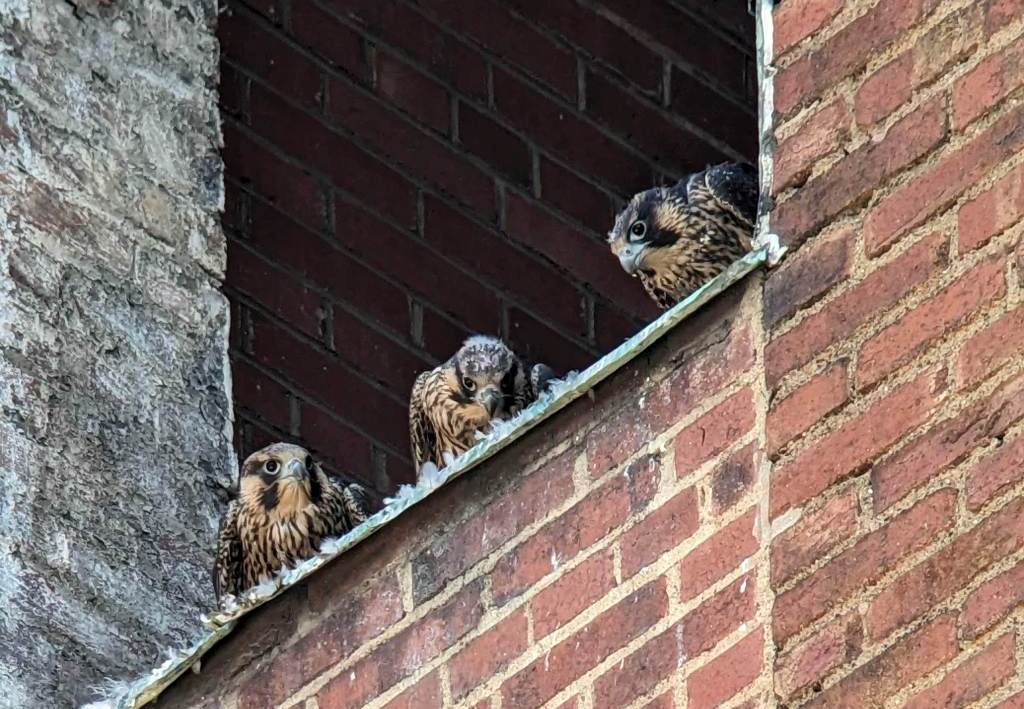
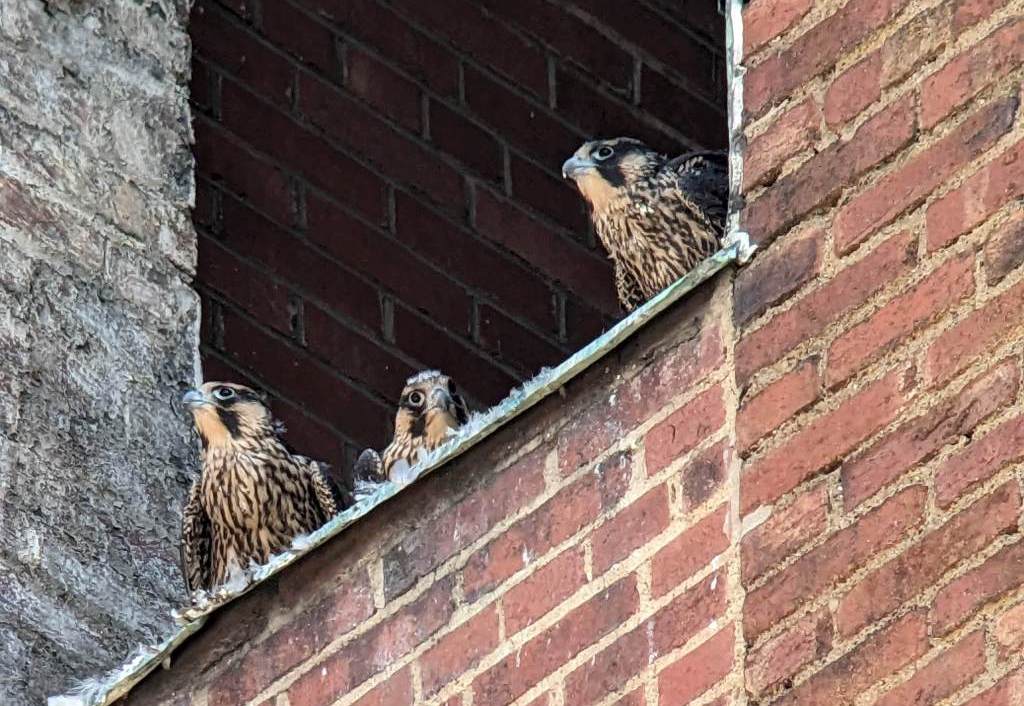
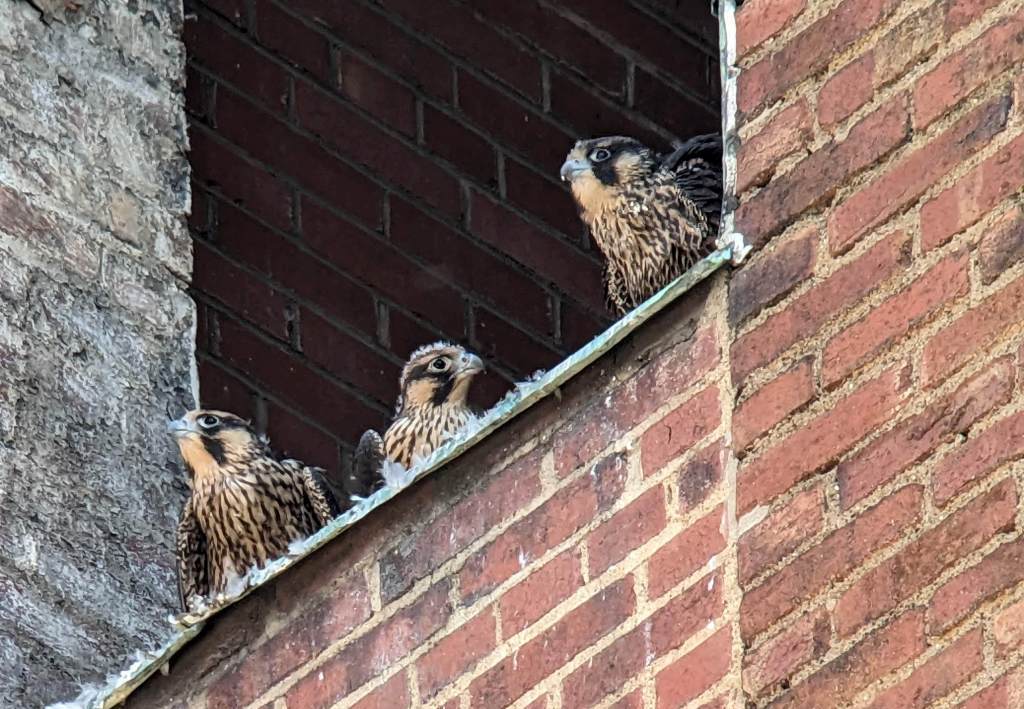
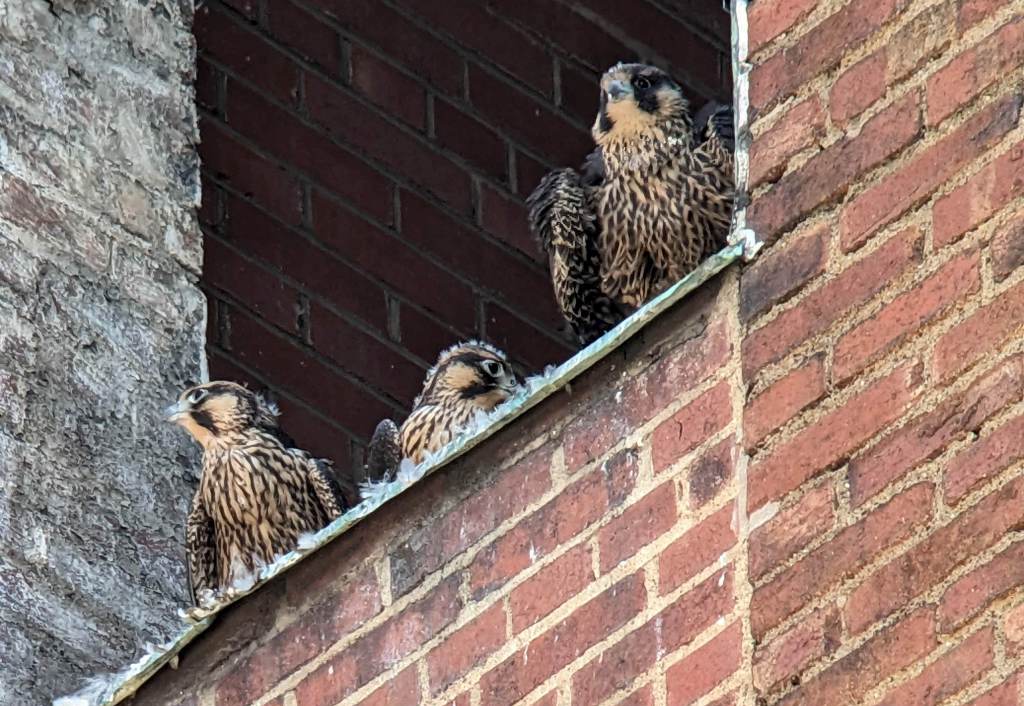
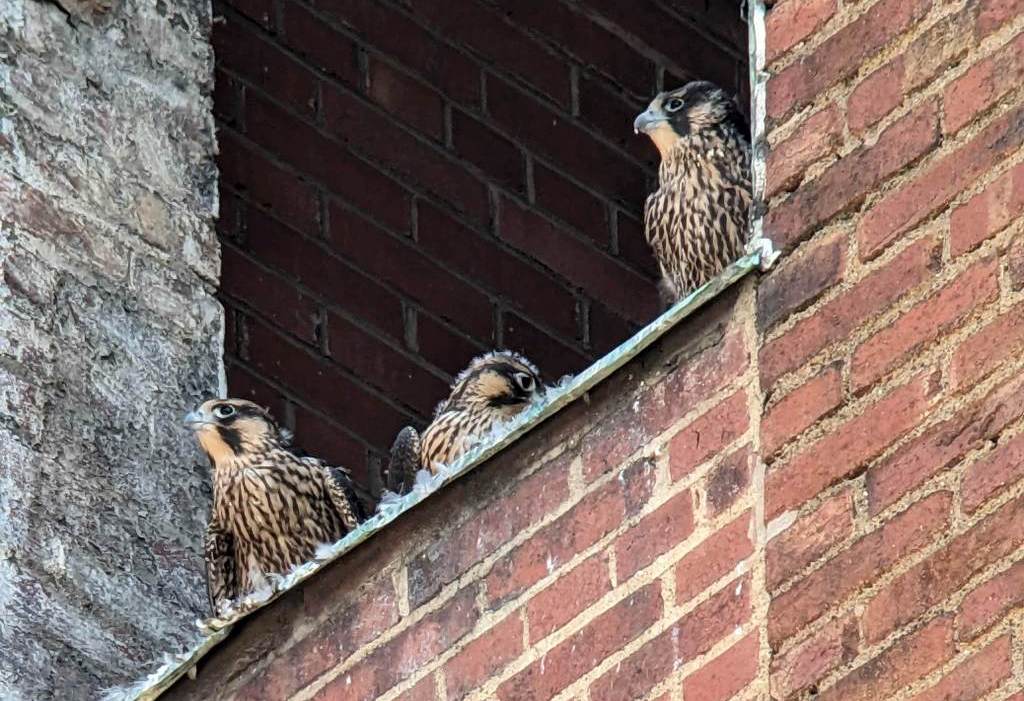
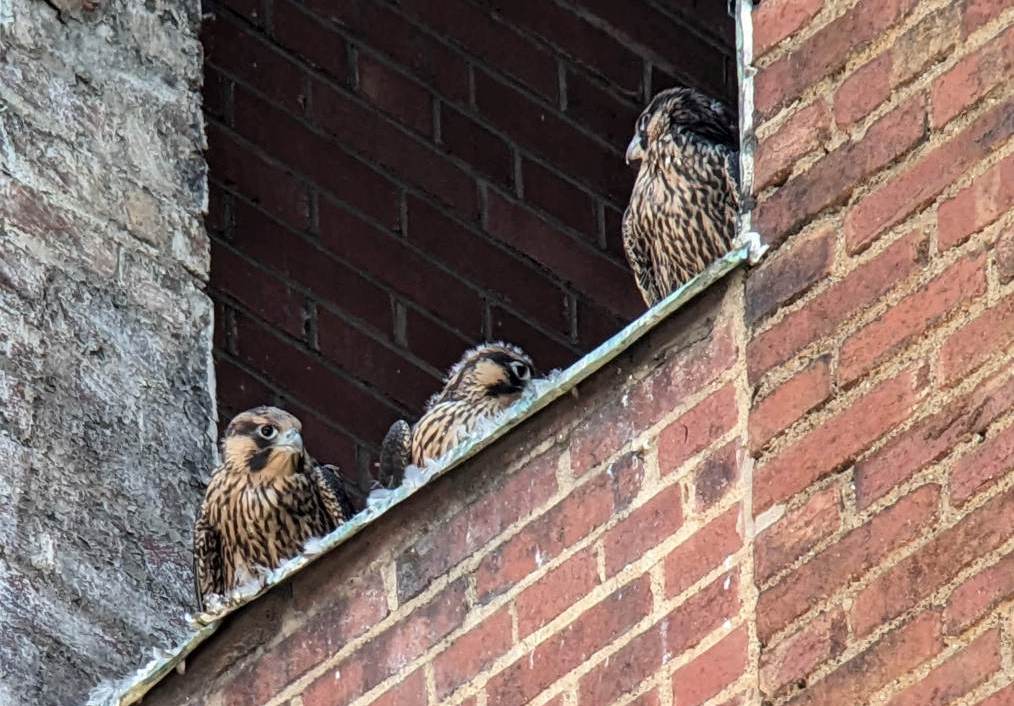
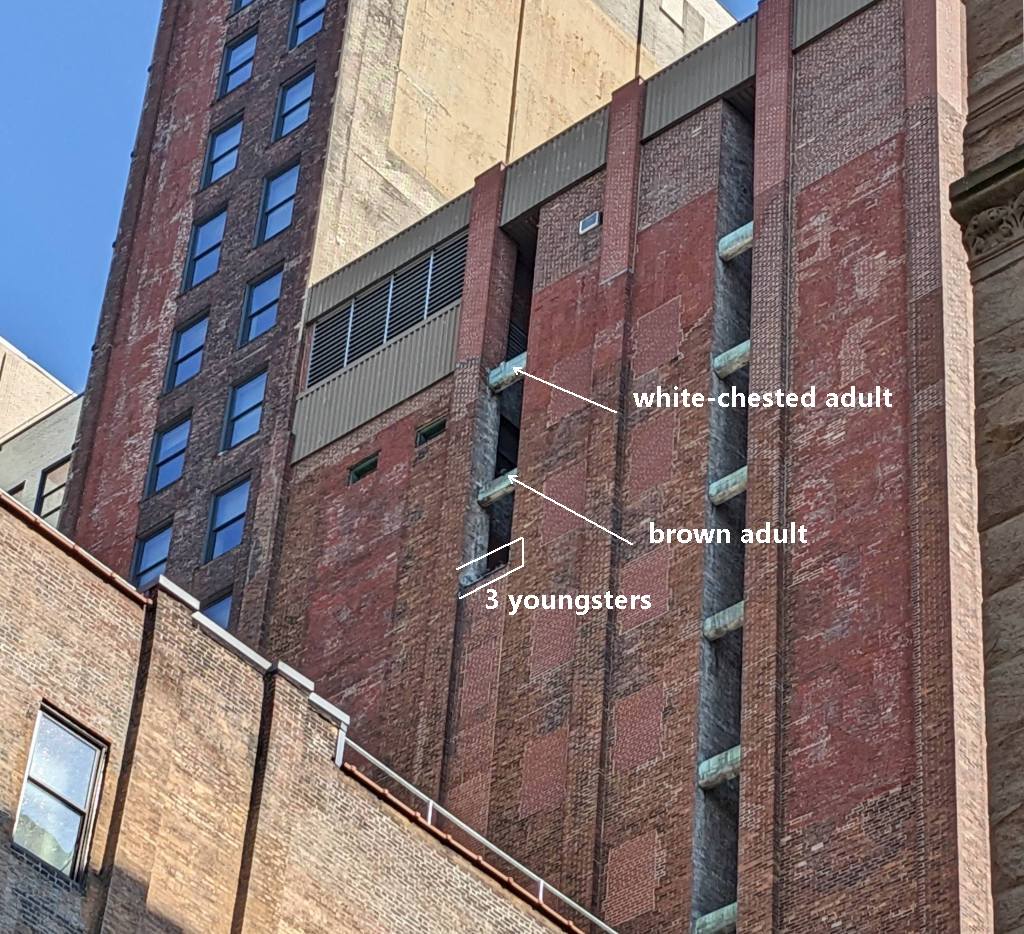
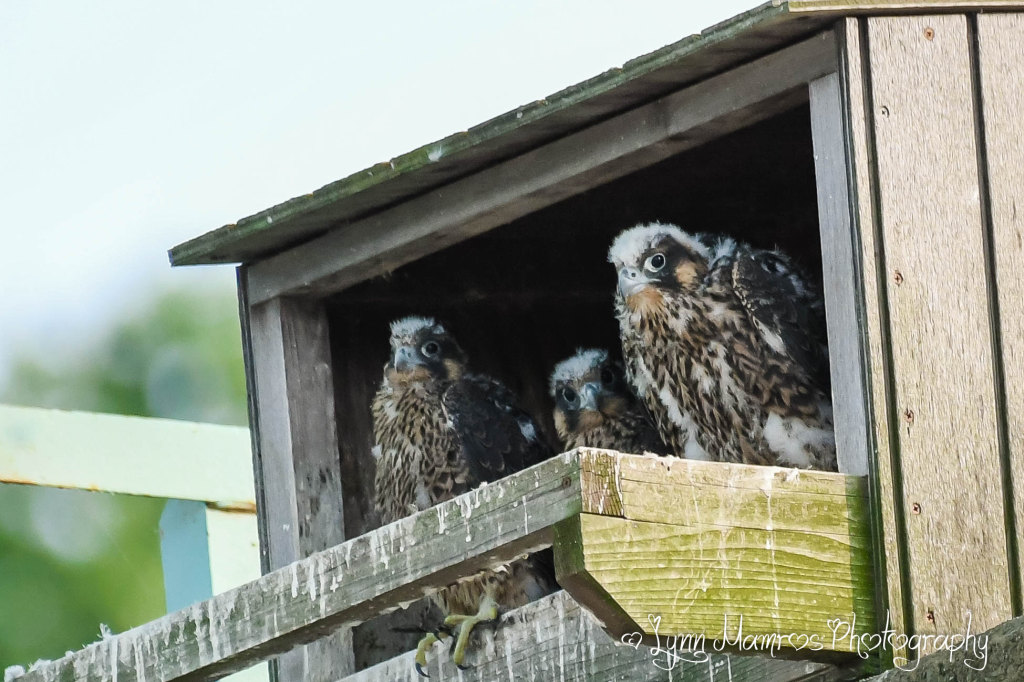
Yesterday morning I stopped by Third Avenue to see if any peregrines were visible and was lucky to see the entire family. Three youngsters perched at the ledge opening (photos at top) while their parents watched from above on the crossbars. The brown youngsters are exercising their wings and will fledge this week.
Downtown peregrine nest area as seen from Third Ave. Locations of birds noted in white. 3 June 2023 (photo by Kate St. John)
The adults have been a mystery. On 3 March Jeff Cieslak photographed an adult-plumaged pair: an unbanded female (not 16-year-old Dori who was banded) and a male who did not show his legs. When Jeff returned on 14 April he saw a nest exchange that appeared to be a male (unbanded in dark brown immature plumage) bringing prey to a female (banded & in adult plumage). The behavior told us who was who. Or did it?
Here are photos of the adults.
Adult-plumage bird on 18 May and 3 June 2023. Jeff re-checked his photos and saw that this bird has black/red bands and several viewers have remarked that the bird’s face is like Terzo’s. This is the male, Terzo.
Adult plumage peregrine at Third Avenue, 18 May 2023 (photo by Jeff Cieslak)Adult plumage peregrine at Third Ave, 3 June 2023 (photo by Kate St. John)
Photos of the dark brown bird on 28 May and 3 June 2023 are more of a mystery. The flank stripes are horizontal so this is adult plumage. This dark brown unbanded bird is the female. More on her color in a future article.
Dark plumaged peregrine at Third Avenue Downtown, 28 May 2023 (photo by Kate St. John)Dark plumaged peregrine at Third Avenue Downtown, 3 June 2023 (photo by Kate St. John)
Stop by Third Avenue in the next few days to see the youngsters fledge.
3 chicks in red-tailed hawks’ nest, Schenley Park, 28 May 2023 (photo by Charity Kheshgi)
31 May 2023
Spring nesting season is continuing apace. The first batch of baby robins is learning to fly and some are old enough to forage on their own. Raptor fledglings are not far behind.
On Sunday 28 May we watched three red-tailed hawk chicks in a nest under the Panther Hollow Bridge in Schenley Park. This species hatches in the order the eggs are laid, each one two days younger than the last. The chicks clearly show their age difference in Charity Kheshgi’s video. One chick is getting ready to fly, one is still fluffy, and the middle one is halfway between.
Red-tailed hawks’ nest, Schenley Park, 28 May 2023 (video by Charity Kheshgi)
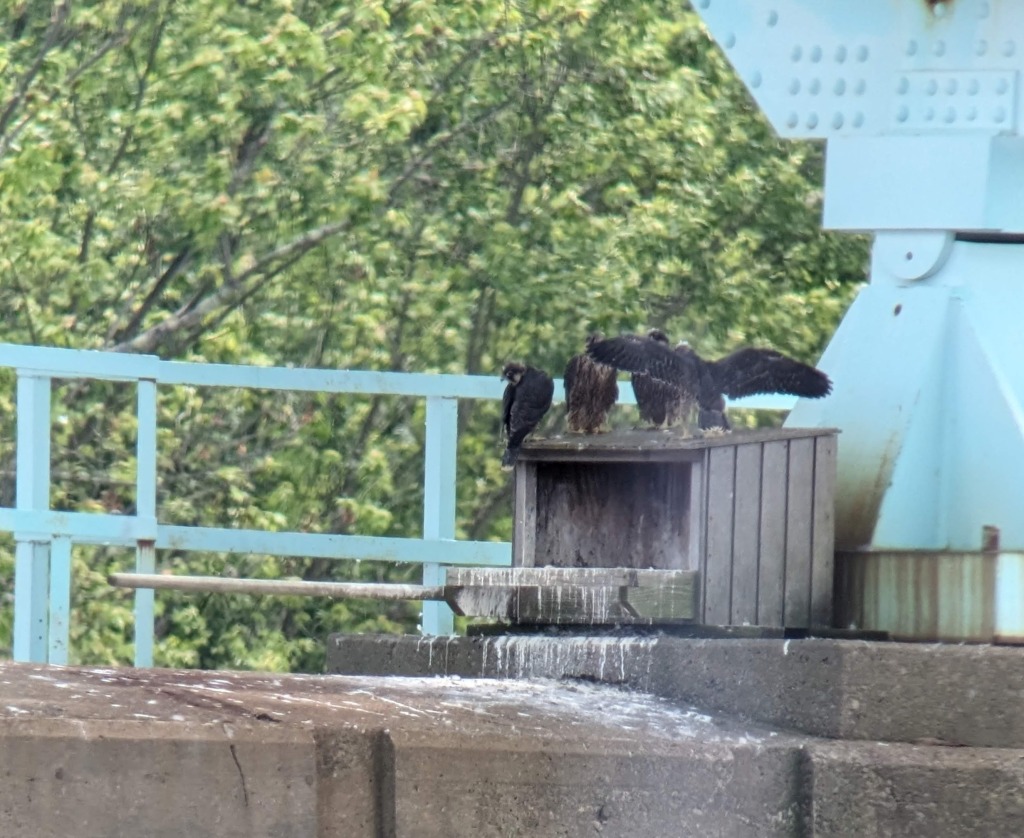
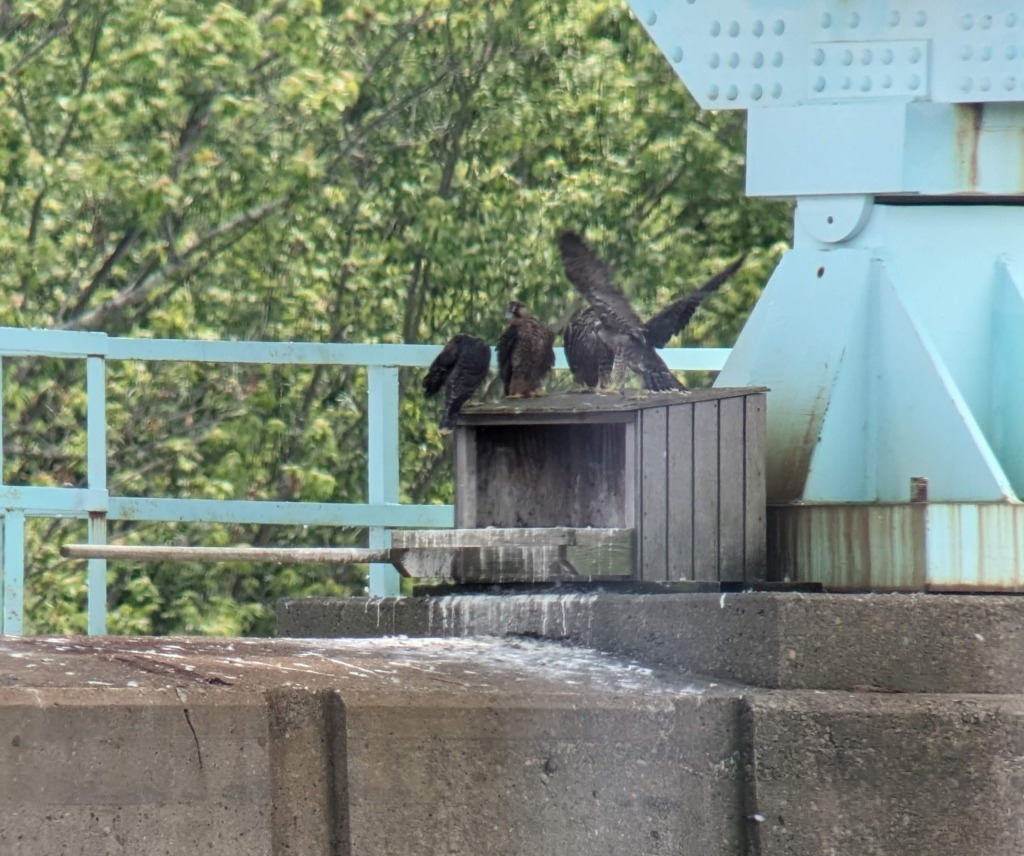
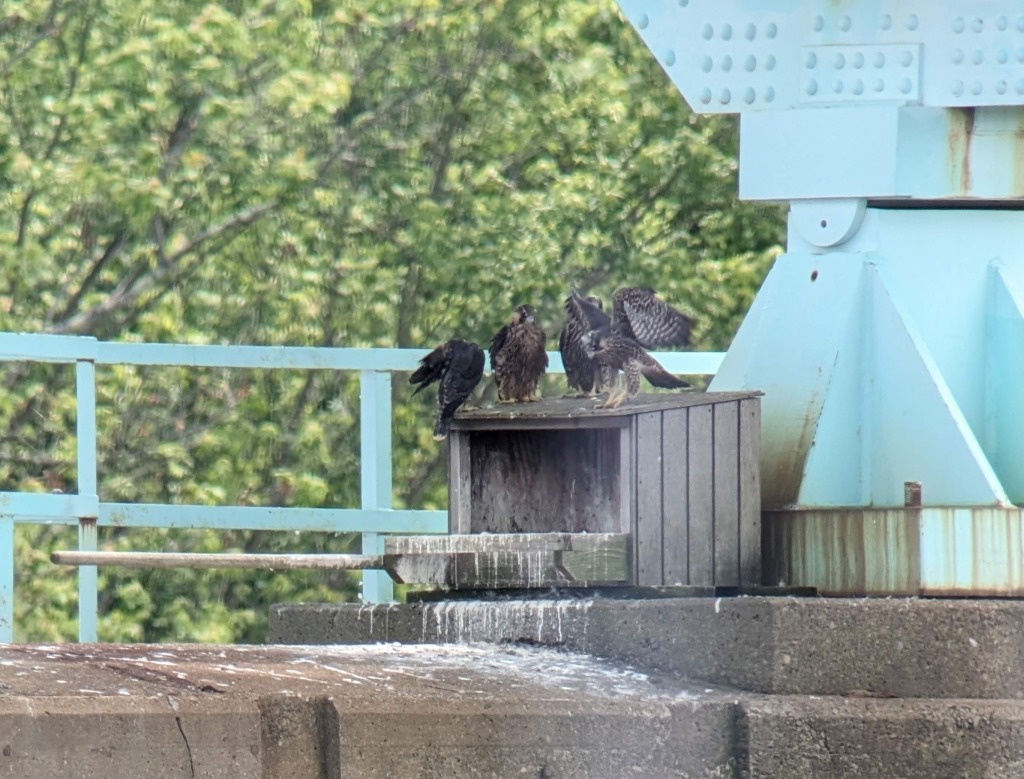
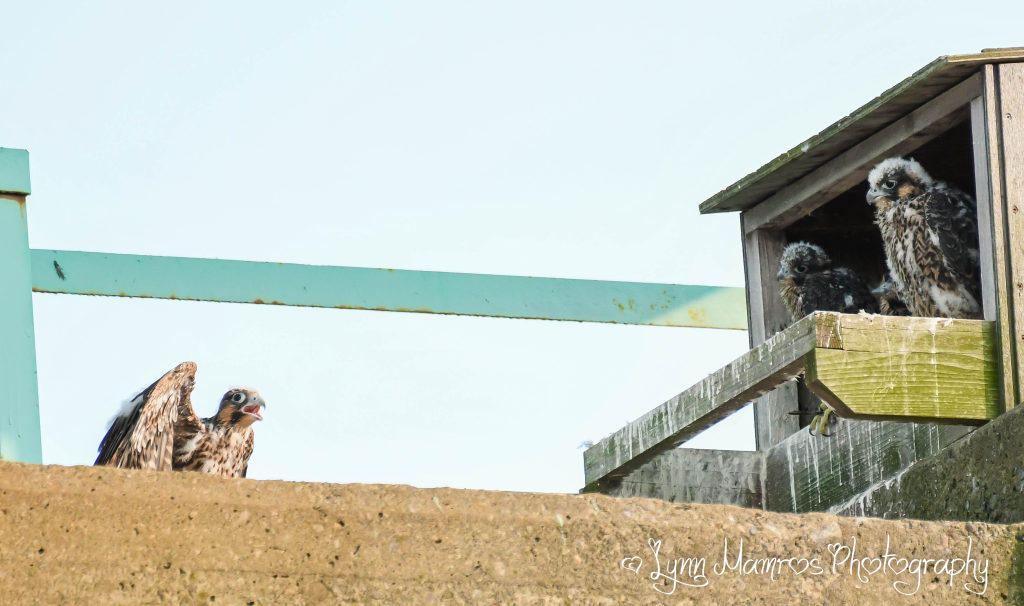
At the Tarentum Bridge on Sunday afternoon, John English and I watched three peregrine chicks lounging on top of the nestbox while an adult “babysat” nearby.
Adult female peregrine watches her ledge-walking chicks at the Tarentum Bridge, 28 May 2023 (photo by John English)
At first we saw only three chicks but after we moved to a better viewing location the fourth was on the top of the box as well, exercising his wings.
Four peregrine chicks at Tarentum Bridge, 28 May 2023 (photo by Kate St. John)Four peregrine chicks at Tarentum Bridge, 28 May 2023 (photo by Kate St. John)One chick concentrates on exercising his wings (photo by Kate St. John)
And suddenly I saw him fly the length of the pier to the other end and back again to the top of the box! I have no photos of this feat but you get the idea. By today he may have fledged from the bridge.
Female peregrine clutching prey and shouting, West Brownsville Lane Bane Bridge, 26 May 2023 (photo by Jeff Cieslak)
30 May 2023
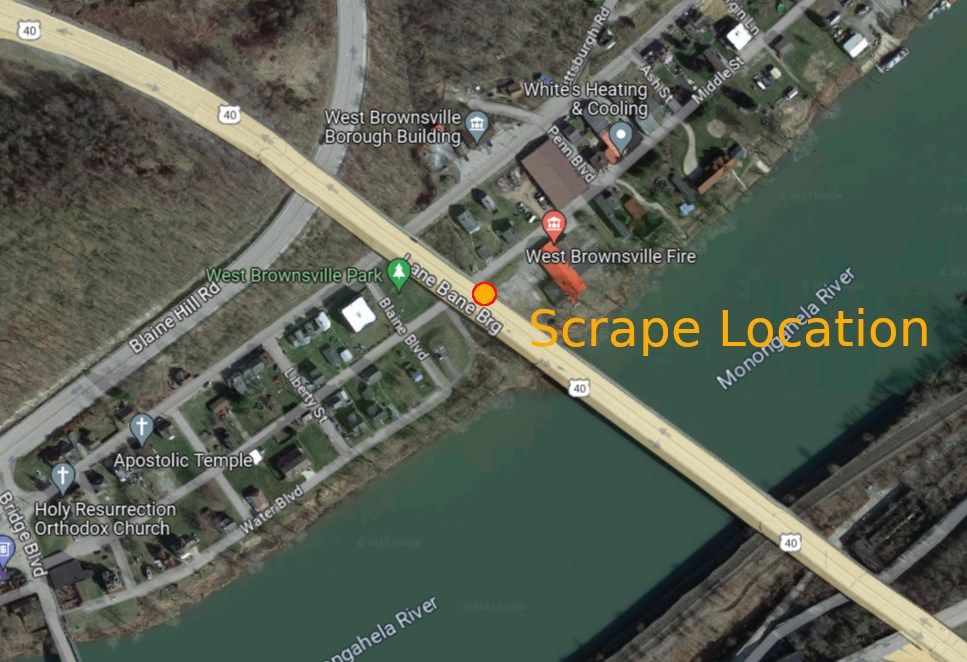
Last Wednesday, 24 May, Mark Vass drove down the Monongahela River valley looking for birds and checking bridges. In West Brownsville he found a peregrine perched under the US Route 40 Lane Bane Bridge. Mark’s checklist and photo set off a quest to find the nest (https://ebird.org/checklist/S139102470)
Jeff Cieslak made the trip on Friday 26 May and found the nest hole and a pair of peregrines carrying food to it. The female is peachy with heavy dots, the male is whiter. Neither bird is banded. (My male-female assessment is based on the tendency of mid-latitude males to be paler than females. Notice that both have the adult plumage trait of horizontal stripes on their flanks.)
Male peregrine, West Brownsville Lane Bane Bridge, 26 May 2023 (photo by Jeff Cieslak)Male peregrine, West Brownsville Lane Bane Bridge, 26 May 2023 (photo by Jeff Cieslak)
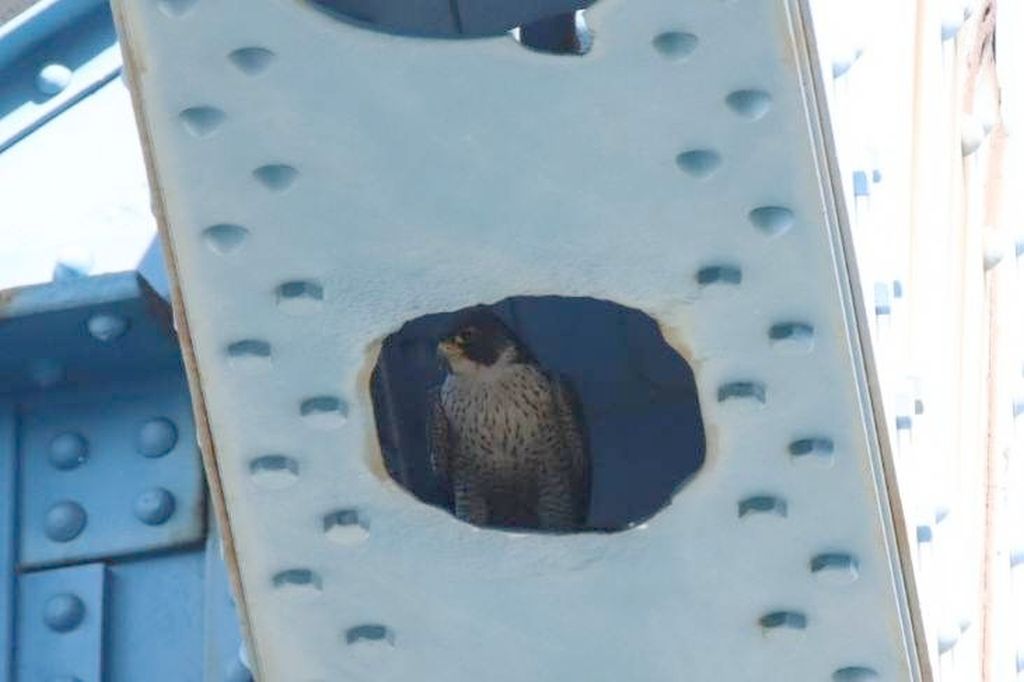
Alyssa Nees and Fred Kachmarik visited on Memorial Day, 29 May, and counted a family of five — two adults, three chicks. Alyssa’s photos show an adult in the nest hole …
Peregrine inside the nest area on the Lane Bane Bridge, West Brownsville, PA, 29 May 2023 (photo by Alyssa Nees)
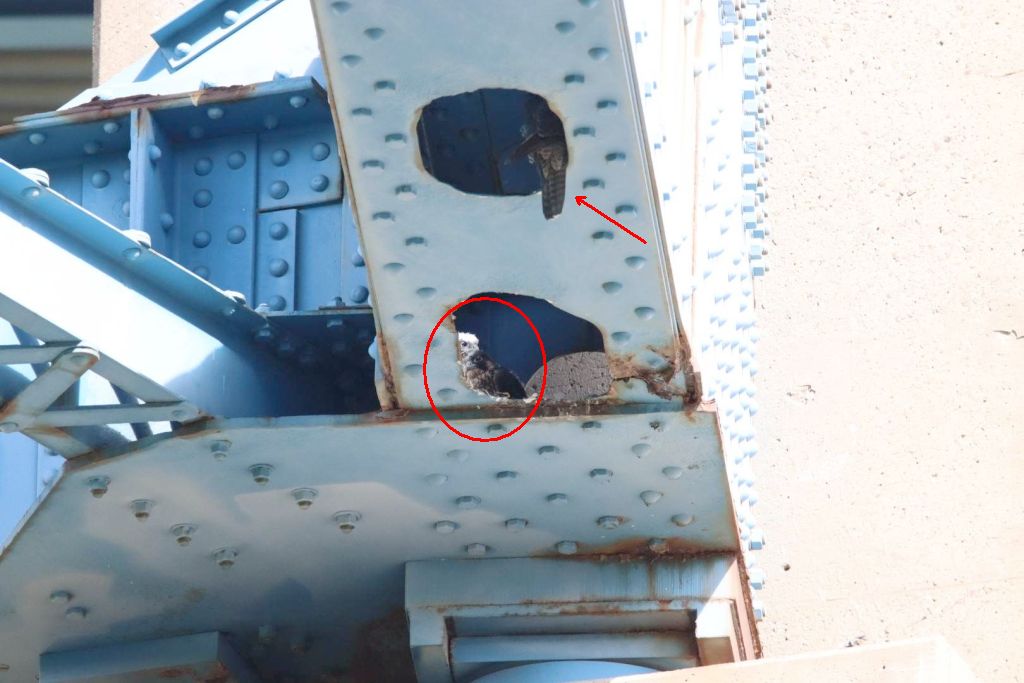
… and a chick clearly visible (red circle) with fluffy white top of head, feathered face and brown back. The arrow points to the tail of an adult watching from above.
Adult peregrine (arrow) and fluffy white head, face & brown back of nestling (circle) at Lane Bane Bridge, 29 May 2023 (photo by Alyssa Nees)
Fred’s photos of the chicks include an older chick and a fluffy young one:
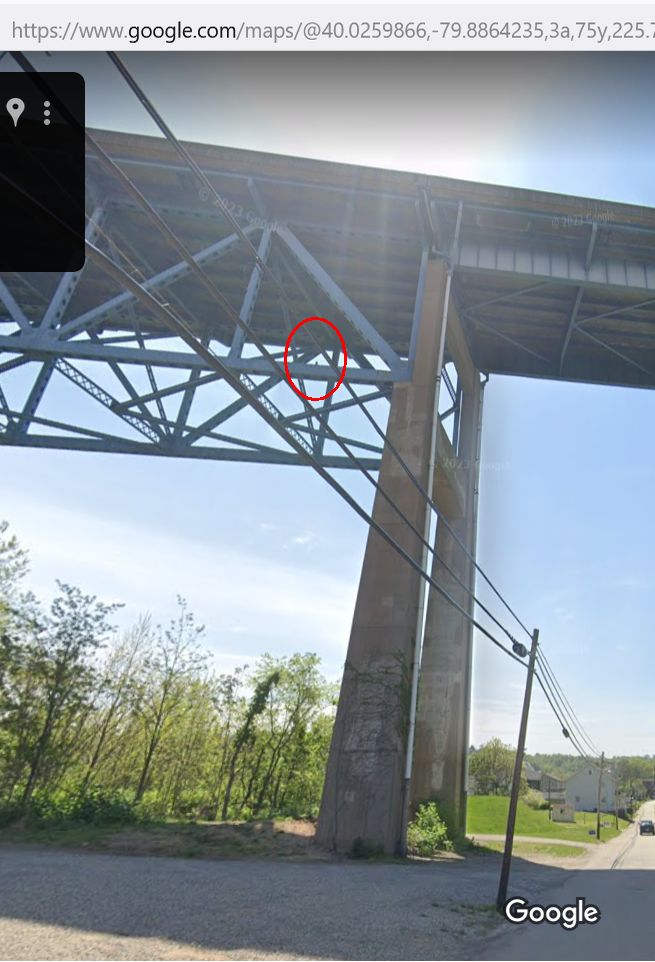
A truss structure spans the river and ends at a pillar on each side. As far as I can tell from the photos, the nest appears to be close to the pillar. So these birds are nesting in Washington County, PA.
Interestingly, when Google Street View cameras drove by on the West Brownsville side this month, the cameras “saw” a bird perched on the superstructure near the pillar. I’ll bet this dot is a peregrine.
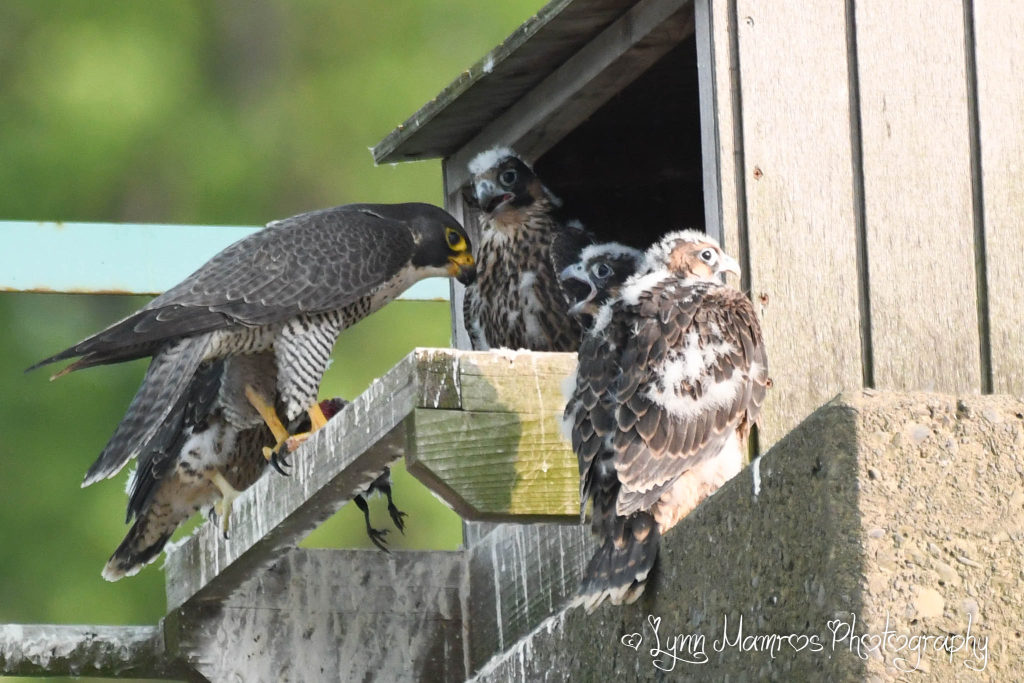
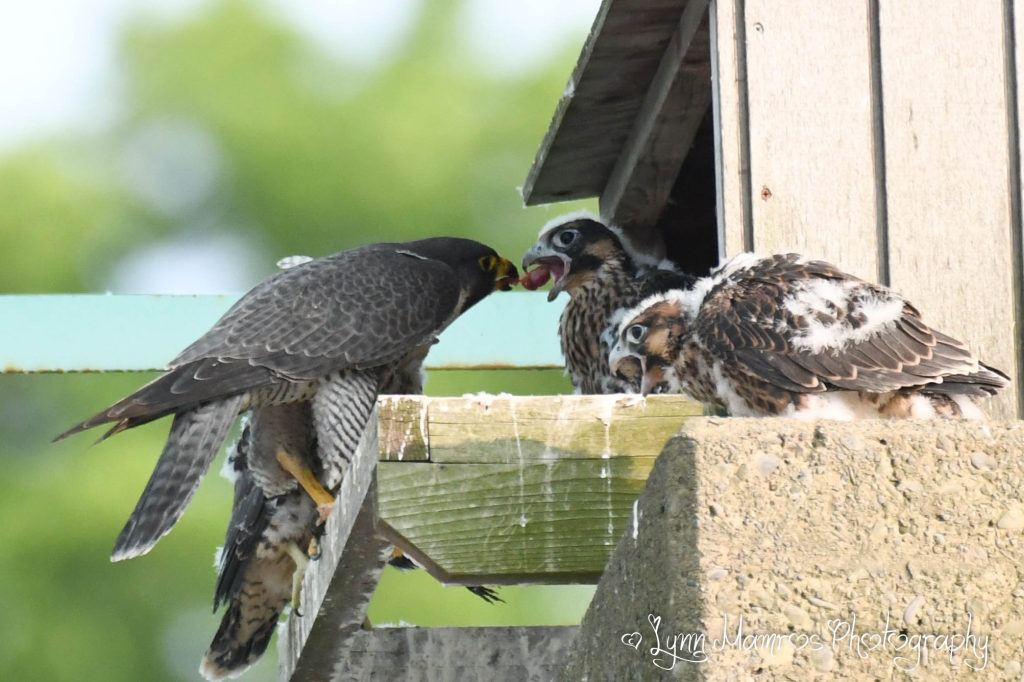
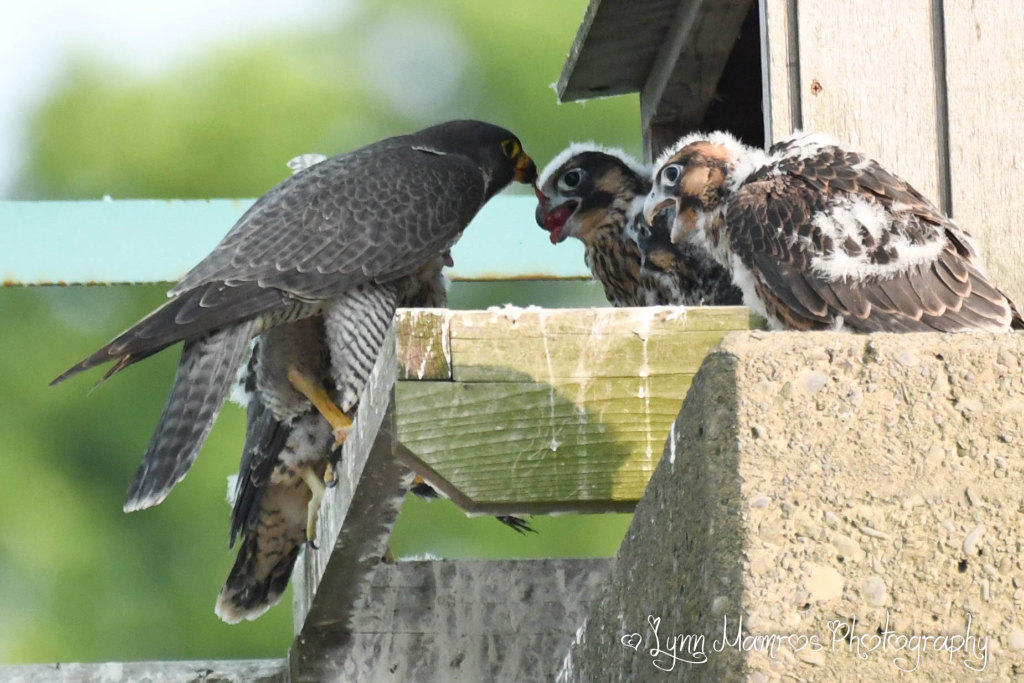
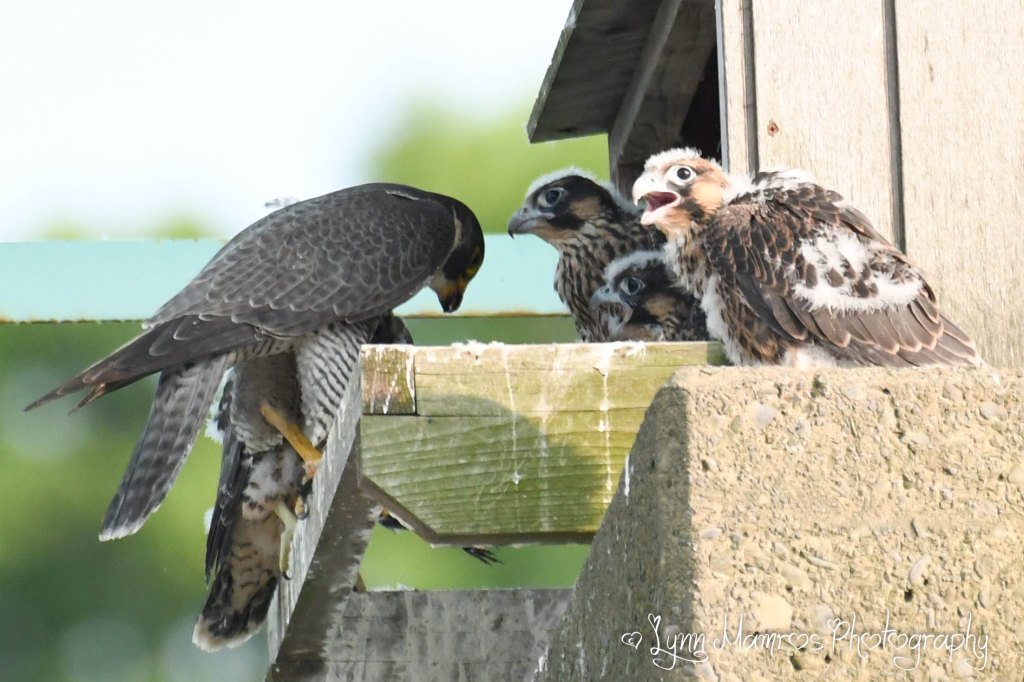
Female peregrine feeding 4 young at Tarentum Bridge, 21 May 2023 (photo by Lynn Mamros)
26 May 2023, Pittsburgh
Are you in town for the Memorial Day weekend and wondering how to spend the time? Visit these peregrine sites to watch young birds getting ready to fly.
Cathedral of Learning, Univ of Pittsburgh: This is the only site without eggs or young but there’s a new female, Carla, since 14 May. Carla and Ecco are courting intensively. Will this prompt her to lay eggs? Watch the National Aviary falconcam at Univ of Pittsburgh to find out.
Female peregrine at Third Ave nest area, 18 May 2023 (photo by Jeff Cieslak)
Eckert Street near McKees Rocks Bridge, Ohio River: Watch for the chicks to appear where the parents are standing in this photo by Jeff Cieslak. Click here for the map.
Peregrine pair at the nest, Eckert Street, 24 May 2023 (photo by Jeff Cieslak)
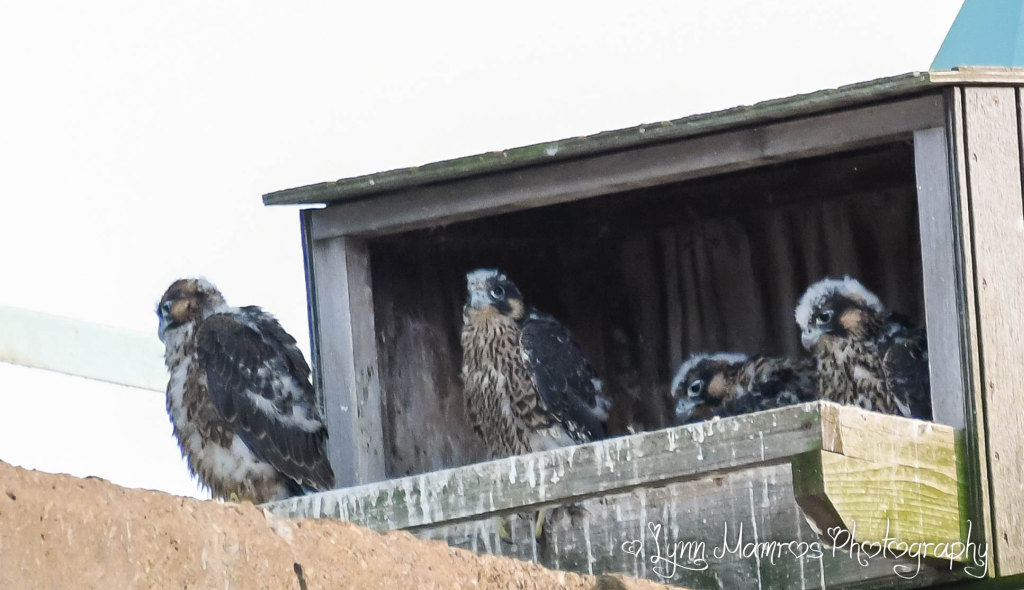
3 of the 4 young peregrines at Tarentum Bridge, 21 May 2023 (photo by Lynn Mamros)
24 May 2023
If you want to see young peregrine falcons just before they fly, now is the time to do it. Four youngsters at the Tarentum Bridge are ledge walking and will make their first flight soon.
Last Sunday, 21 May, Lynn Mamros photographed the family.
Peregrines at Tarentum Bridge, 21 May 2023 (photo by Lynn Mamros)
The father peregrine brought in food …
Parents bring food to Tarentum Bridge, 21 May 2023 (photo by Lynn Mamros)
… the mother peregrine plucked it …
Female peregrine preparing a meal for the chicks, 21 May 2023 (photo by Lynn Mamros)
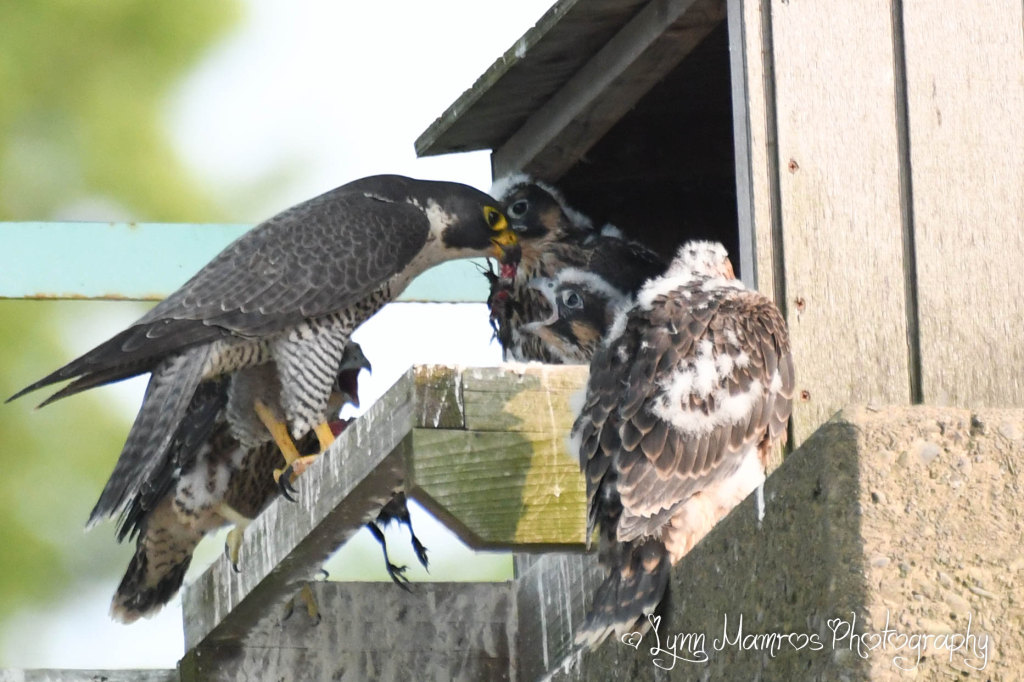
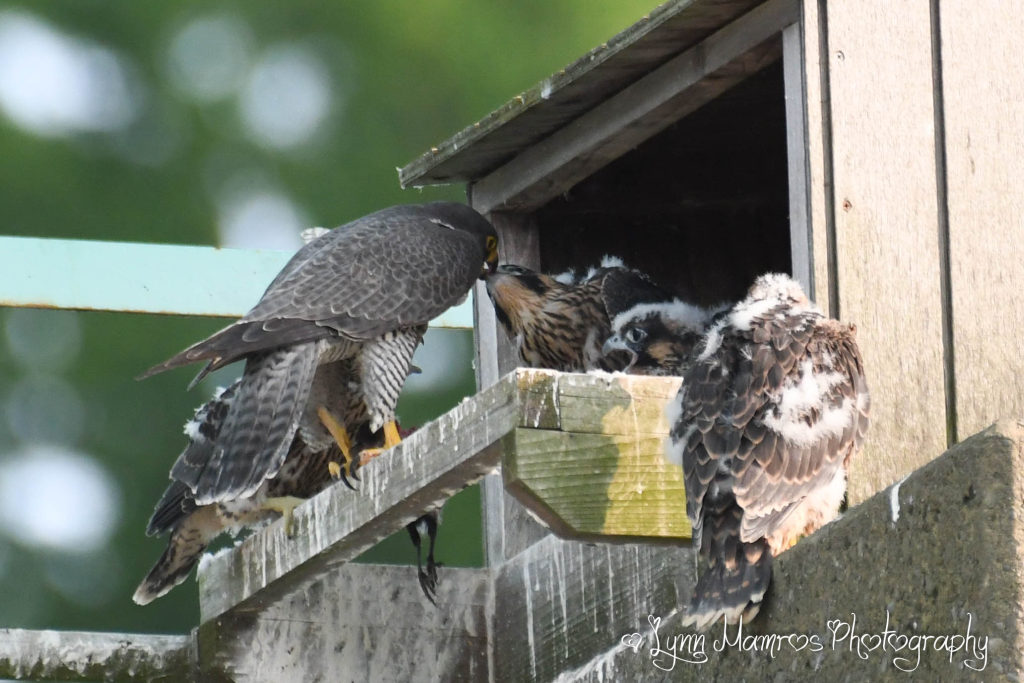
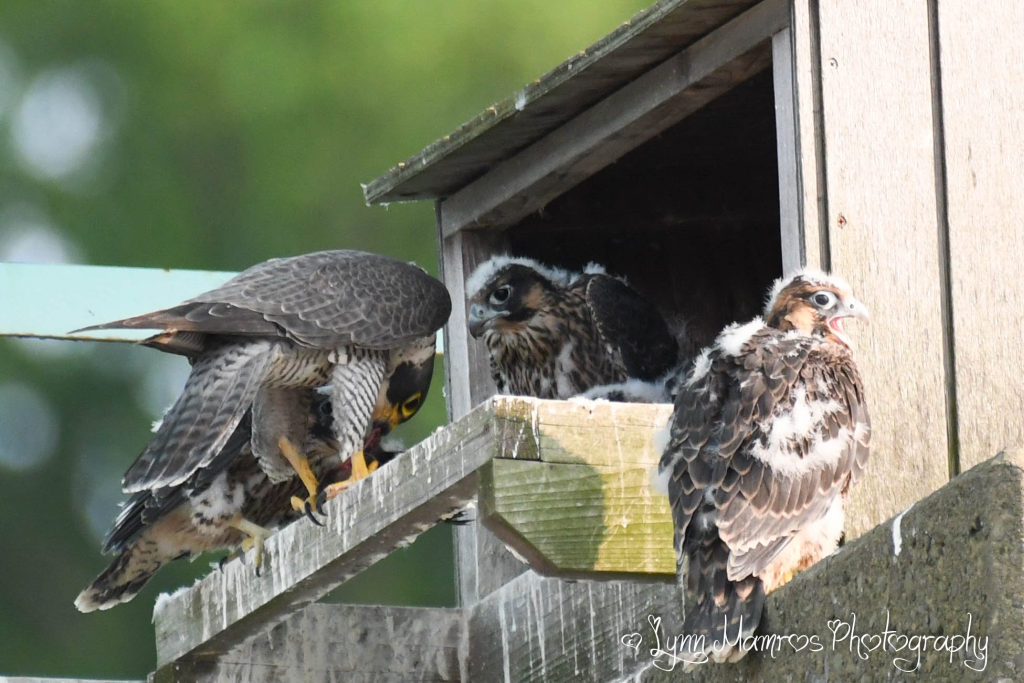
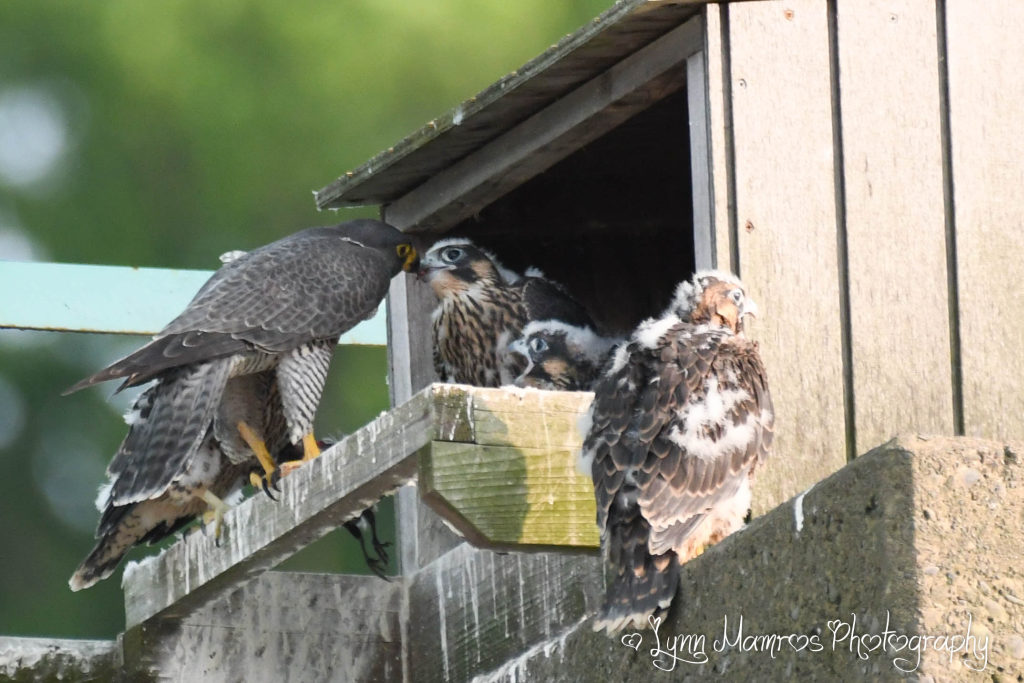
… and then the feeding began. All four chicks are visible in most of these slides. Can you see them? (Hint: One’s on the perch.)
The youngsters are losing their fluff and will soon be completely brown.
Peregrines at Tarentum Bridge, 21 May 2023 (photo by Lynn Mamros)
And then they will fly. Don’t miss it! Visit the Tarentum Boat Ramp to see them. Click here for a map.