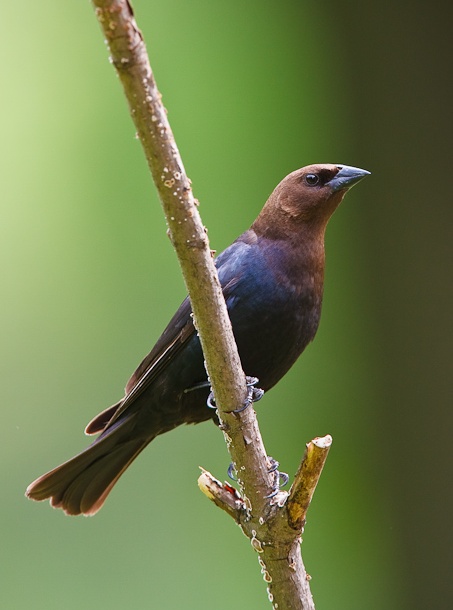
For weeks I thought that all the brown-headed cowbirds had left Schenley Park, that the females had dumped their eggs in other species’ nests and moved on. But I was wrong.
The cowbirds arrived in mid-April and immediately made themselves noticeable. Males called from the treetops and as many as three puffed and courted a single female. I felt bad for the song sparrows, their most likely victims in Schenley, who would be forced to foster those cowbird eggs-in-the-making.
The cowbirds mated, the females dumped their eggs, and then they disappeared. Or so I thought.
As expected, in late May I saw and heard cowbird fledglings begging from song sparrow parents.
In early June I was surprised to hear male cowbirds singing again. According to the literature they’d never left but had spent the intervening weeks monitoring the host nests to make sure their kids alone survived.
By now the young cowbirds are self-sufficient but they were raised in a song sparrow world. It’s time for them to learn how to be cowbirds (and for their mothers to lay another batch of eggs) so their fathers are singing.
“Hey, kid. You’re a cowbird. Come with me.”
(photo by Brian Herman)
p.s. See Meredith Lombard’s photo of a chipping sparrow foster parent feeding a cowbird fledgling and a Louisiana waterthrush with its baby cowbird. Notice that the foster parent is smaller than the baby. 🙁
It’s such a shame that they are a parasitic species (I think that’s the term) … their song is so pretty
I was dismayed to see a song sparrow feeding a cowbird chick in my yard this spring. When I first discovered these birds years ago, I tried to learn as much as I could about them. One thing still puzzles me: “City” cowbirds don’t have to follow a herd of cows to eat the insects the cows kick up, so why hasn’t their behavior changed – why don’t they stay and raise their own chicks?
It turns out that cowbirds couldn’t raise their own chicks if they wanted to. They don’t form a brood patch — the bare skin area that allows direct (heated) contact with the eggs — even though they have normal levels of the hormone that induces a brood patch in related species. (factlet from Birds of North America Online)
Thanks for the answer, Kate.
how large are they? I think I had a cowbird on my balcony just a half an hour ago, but it took off before I could take a picture. (July 4 2012)
They are larger than sparrows, smaller than robins. Their head shape & beaks look more like sparrows’ than robins’.