Category Archives: Migration

Veerys Know When Bad Hurricane Season is Coming & Leave Early for Brazil

Veery on migration, early May 2008 (photo by Chuck Tague)

18 August 2025

This news from 2018 is worth repeating.

Back in May 2025 NOAA predicted a strong hurricane season this year so it was a little surprising how quiet the ocean was this summer … until now. Last Friday Tropical Storm Erin was upgraded to a hurricane and quickly grew to Categories 4 and 5. Is this the start of the strong season we expected? Veerys could tell us the answer if we knew this spring’s nesting status and whether they’ve already left on migration.

Veerys (Catharus fuscescens) breed in cool climates in North America and spend the winter in Brazil. Banding and tracking studies found that southbound veerys never travel overland through Mexico. Instead they always cross the Caribbean to get to the Yucatan, Central and South America. Even northwestern breeders begin by traveling east to later fly across the Gulf. (Their path is actually a great circle route.)

I’ve marked up the veery range map to show some of their southbound routes across the Gulf.

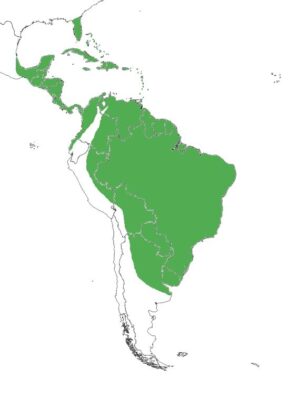
Veery range map. Cross-Caribbean migration routes added (map from Wikimedia Commons)

Veerys have been studied in Delaware since 1998. In 2017 with decades of data on nesting outcomes and fall departure times, ornithologist Christopher Heckscher discovered an amazing correlation. In bad hurricane years, Delaware’s veerys abbreviate the breeding season and leave in midsummer on migration. This timing happens to get them safely across the Caribbean before the hurricanes hit.

By midsummer 2017, Heckscher knew the veerys had shortened their breeding season so he boldly predicted a bad hurricane season even though meteorologists had already said otherwise. When the season was over it was true. The veerys were right. Heckscher published a paper on this in Scientific Reports in 2018.

Heckscher has a theory on why veeries know this:

 Heckscher hypothesizes that, on their wintering grounds, they may notice precipitation patterns linked to the El Niño and La Niña cycles that influence hurricane activity. “Whatever it is, they know by mid-May,” he says, explaining that the average date of all nesting attempts in years with low ACE(*) was after May 23. 

Audubon Magazine: August 2019: Are These Birds Better Than Computers at Predicting Hurricane Seasons?

So have the veerys abbreviated their nesting season this year and already left for Brazil? I’d really like to know.

For more information, see this August 2019 Audubon Magazine article and Heckscher’s paper A Nearctic-Neotropical Migratory Songbird’s Nesting Phenology and Clutch Size are Predictors of Accumulated Cyclone Energy.

(*) ACE is Accumulated Cyclone Energy, a numeric measure of hurricane season intensity. A low number means it will be a low-activity hurricane season; high is bad.

Swallow-tailed Kites Are on the Move

17 August 2025

On Friday morning 15 August Michele Beresh made her daily stop at Palmer Park to check on the swallow-tailed kite she first saw at Donora on 8 August. Her photo, above, was the next-to-last time(*) the bird was seen before it left that day on migration. UPDATE 18 August, 5am: The kite was seen on 17 August.

While “our” kite spent last week with us, thousands of others assembled in the southeastern U.S. ahead of their 5,000 mile migration to Brazil. Many have already left the U.S. including the 291 swallow-tailed kites that flew by the Florida Keys Hawk Watch yesterday. Isaiah Scott @ikesbirdinghikes tells their story (posted 15 Aug 2025).

With a long journey ahead of them, the kites take their time in the fall.

The whole southbound trip may take a Swallow-tailed Kite anywhere from 8 weeks to 3 months. For the most part, they don’t rush. Instead they move at a slow but persistent pace, feeding as hunger and food availability dictate until reaching their wintering destinations. Unlike their northbound migration, when mates and a short nesting season await them, their southbound journey seems unhurried.
ARCI: The Kites Migrate South, 13 August 2018

We know about this timing because the Avian Research and Conservation Institute (ARCI) has been tracking swallow-tailed kite migration via satellite and GSM since 1996. Some kites dawdle so much in the fall that they don’t reach their favorite wintering grounds until December. Then they turn around just six weeks later and head north at a faster pace.

Learn about this year’s cohort of 20 tagged swallow-tailed kites that are already en route to Brazil and see their maps at ARCI: 2025 Aerial Research Team Roster: Meet the Swallow-tailed Kites.

Some Barn Swallow Pairs Stay Together Year Round

Barn swallows at Point Pelee, Ontario (photo from Wikimedia Commons)

12 August 2025

At this time of year barn swallows form flocks as they migrate south. During the day you may see them swooping through bug-laden air or perched on dead branches to pause and preen. Are they traveling with friends or in a flock of unrelated birds?

Barn swallow flock in South Africa (photo from Wikimedia Commons)

We assume that, unlike crows and geese, barn swallows don’t travel in family groups. However, an intriguing study published in 2015 discovered that at least one pair stayed together all year. This discovery was made possible when barn swallows breeding in Spain were fitted with small geolocators to find out where they went. Among them two breeding pairs were tagged and tracked.

The results of a study using light-level geolocators suggest that the male and female of a breeding pair could have migrated and wintered together, as they left their breeding area in northern Spain on 9 September, arrived to a same overwintering area in West Africa around 20–21 September, started the northward trip on 20 March and were back in the breeding site around 10–11 April, the coincidence in the temporal timing seeming highly unlikely to occur by chance for individuals that are not associated.

Birds of the World: Barn Swallow Migration

The screenshot below gives you an idea of the size and shape of light-level geolocators. For example, Lotek’s MK 5720 Geolocator for birds are quite small. The background photo shows a snow bunting wearing one.

MK avian geolocator on a snow bunting, the size of a paperclip (image from Lotek.com website)

The simplest geolocator analysis derives latitude from day length and longitude from solar noon, which is relatively straightforward (Hill, 1994).

Wiley Online Library: Light-level geolocator analyses: A user’s guide

When two mated pairs of barn swallows completed their journey the data provided pinpoint locations all the way to West Africa.

One of the tagged pairs stayed together on migration, at the wintering grounds, and returning to the breeding grounds. Another tagged pair did not.

There’s no way we’ll know if any North American pairs stay together year round, but it’s nice to imagine such fidelity.

Meanwhile, watch for barn swallows passing through our area on their way to Central and South America for the winter. They’ll reach peak numbers this week and taper off quickly. By 30 August they’ll be scarce in southwestern PA and be gone completely by mid September, as shown on the 9 Aug and 30 Aug abundance maps below from eBird.

Barn swallow abundance, weeks of 9Aug and 30Aug, eBird Status and Trends

Swallow-tailed Kite at Donora

Swallow-tailed kite in Florida, March 2015 (photo by Chuck Tague)

12 August 2025

On Friday 8 August Michele Beresh reported a swallow-tailed kite (Elanoides forficatus) flying over Palmer Park, Donora, Pennsylvania at 2pm.

Seen flying at a distance. It looked shiny. Took photos and zoomed in on camera. No mistaking what it is. Tried to follow to get better photos but lost it while driving.

eBird report at Palmer Park, Donora, PA, by Michele Beresh, 8 Aug 2025

Her stunning report was accompanied by this photo at Macaulay Library asset 639995369.

On Saturday morning John Flannigan found it again and Ron Burkert took photos.

PA Lifer. First Washington County PA eBird record. Saw John F returning to car and found out he had just refound the bird. It appeared beyond centerfield then drifted N. Able to see and get overhead views from composting area just beyond pipe gate from parking lot. Medium-sized raptor white and black with DEEP V-shaped tail. Actively foraging, mostly over forest, just beyond Stan “The Man” Musial Field. Numerous photos, including some eating prey while flying.

eBird report at Palmer Park, Donora, PA, by Ron Burkert, 9 Aug 2025

I went to see it Saturday at 2:15pm, watching from a park bench with a 180 degree view. I knew the bird would be hunting for dragonflies and I was hoping for a view like the one I saw in Florida in 2015, photo at top by Chuck Tague. Instead I saw:

Constantly flying. Distant! Fades in the haze until it wheels & shows its body shape. It took me an hour to notice it though it was probably there the whole time. Had a few good views through the scope.

eBird report at Palmer Park, Donora, PA, Kate St. John, 9 Aug 2025

Yesterday astute County Listers figured out they could stand in Gallatin Sunnyside Park in Allegheny County and see the bird flying over both counties. So now the swallow-tailed kite is recorded in Allegheny County, too. Yes it’s counted wherever the observer is standing.

Why is a swallow-tailed kite here?

Swallow-tailed kites breed in the southeastern U.S. but that’s the northern edge of their range. They leave North America in July and early August to join the year-round population in South America.

Range map of swallow-tailed kite from Wikimedia Commons

However, they are known to wander though they usually stay east of the Appalachians. Sometimes a kite will get as far north as Nova Scotia like the one that was seen there on 18 June 2025 — but they typically don’t visit our area . This bird is quite unusual.

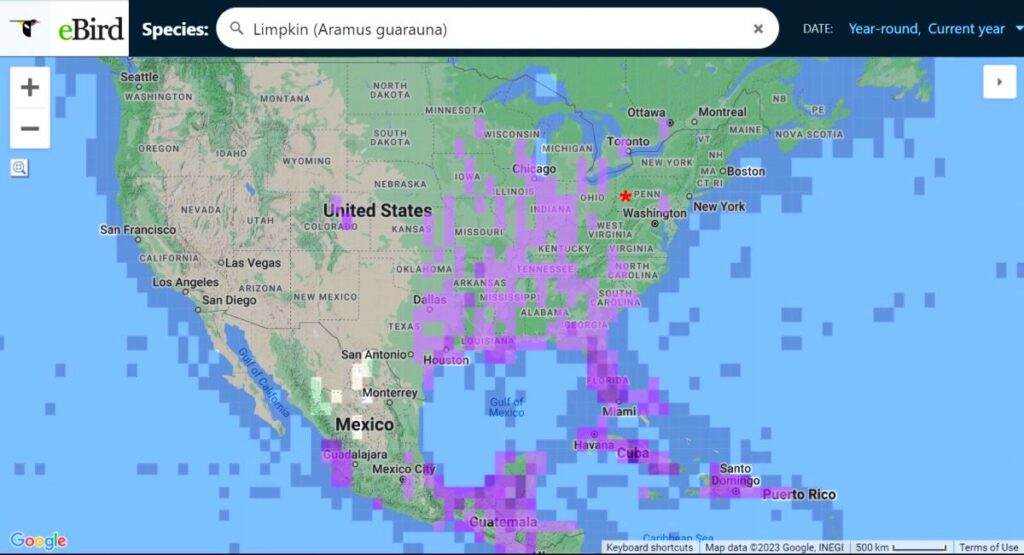
Swallow-tailed kite eBird reports, All Years, zoomed to northeastern US (screenshot)

Late July through early August is peak migration for swallow-tailed kites, especially through the Florida Keys where they sometimes see hundreds per day. Here are some recent reports from hawkcount.org:

2 Aug 2025: Bocas Valle de Agua, Panama, 383 swallow-tailed kites, 216 plumbeous kites
3 Aug 2025: Florida Keys Hawk Watch, 311 swallow-tailed kites
8 Aug 2025: Florida Keys Hawk Watch. 145 swallow-tailed kites
10 Aug 2025: Florida Keys Hawk Watch. Unfavorable winds but still saw 167 swallow-tailed kites

Soon this local bird will head south … but we don’t know when.

For more information:

p.s. Thanks to Michele Beresh for posting it on eBird!

Yellow-Throated Warblers Surge North in September

Yellow-throated warbler, May 2022 (photo by Steve Gosser)

6 August 2025

Yesterday when I wrote about two songbirds who will soon leave Pittsburgh I nearly included yellow-throated warblers (Setophaga dominica) but then I saw their unusual fall migration pattern. Did you know they leave Pittsburgh and West Virginia in early August, then turn around and surge back north into West Virginia in September?

Watch their entire migration in this weekly abundance map from eBird Status and Trends. Then we’ll take a closer look at West Virginia.

Weekly abundance of yellow-throated warblers (animation from eBird Status and Trends)

To set the stage here’s how abundant they are at the height of the breeding season in a screenshot from the week of 7 June.

screenshot from Yellow-throated warbler weekly abundance on 7 June, zoomed in from eBird Status and Trends

Now let’s watch where they go in the last week in July (26 July) through mid October (week of 11 October).

Notice how they leave our area and all of West Virginia in early August, then move back in from the southern Appalachians. Yellow-throated warblers start to leave again during the last days of September and are gone within two weeks.

Slideshow of screenshots: Yellow-throated warbler weekly abundance 26 Jul through 11 Oct zoomed in from eBird Status and Trends

Birders who live in Huntington, WV are well aware of this. Has anyone seen this in southern Greene County, PA? Here in Pittsburgh we’re too far north to see it.

Birds Departing Soon

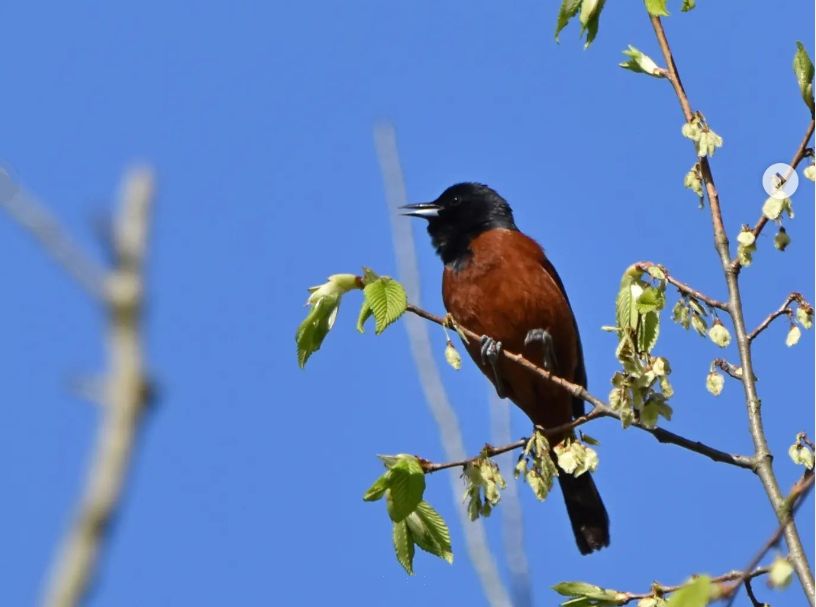
Yellow warbler, Baltimore oriole (photos from Wikimedia Commons)

5 August 2025

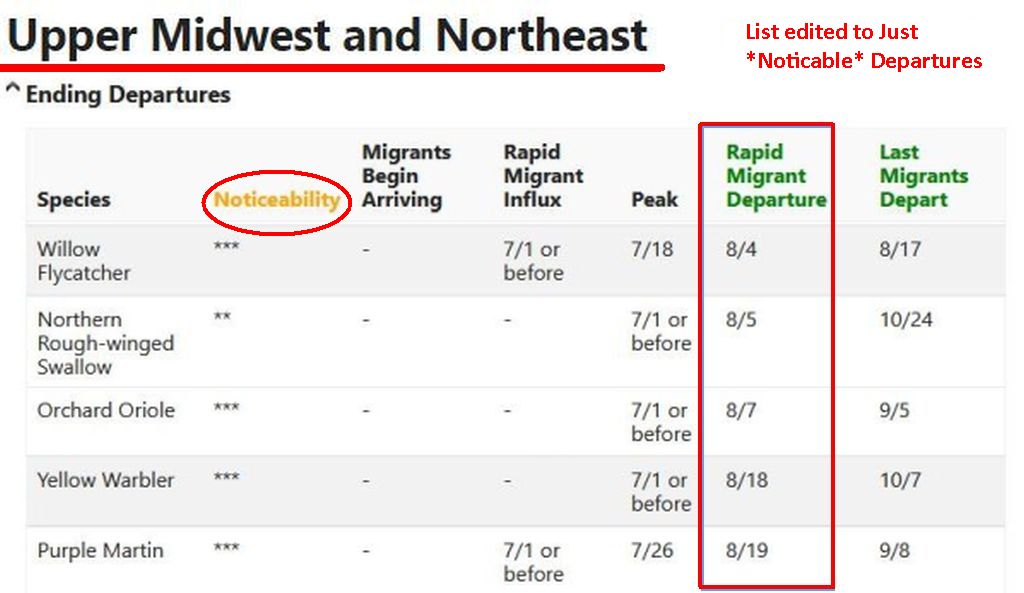
I used to think that songbird migration began when the kids go back to school in late August or early September but that’s not true for these two species. Both are already on migration and will soon disappear from our area.

Yellow warbler (Setophaga petechia)

On a walk near Herrs Island on Friday 25 July I heard six yellow warblers singing. On 3 August I heard only one. Yellow warblers are already on the move and will be gone from Pittsburgh by the week of 16 August. We probably have less than 10 days left to see them. Watch them ebb and flow on the eBird weekly abundance map below this photo.

Yellow warbler (photo from Wikimedia Commons)
Weekly abundance of yellow warblers (animation from eBird Status and Trends)

Baltimore oriole (Icterus galbula)

Unless you have an oriole feeder (offering oranges or jelly) you probably haven’t seen a Baltimore oriole in a while. The males perch prominently in May but seem to disappear while they nest. During July they’re hard to find in Pittsburgh but that’s about to change.

During the week of 9 August those who nested north of us will arrive on migration. Watch for them soon as they pass through Pittsburgh in the next four weeks. They’ll all be gone by 6 September as shown in the eBird Weekly Abundance animation below this photo.

Male Baltimore oriole (photo from Wikimedia Commons)
Weekly abundance of Baltimore orioles (animation from eBird Status and Trends)

The Best 8 Weeks For Pittsburgh Hummingbirds

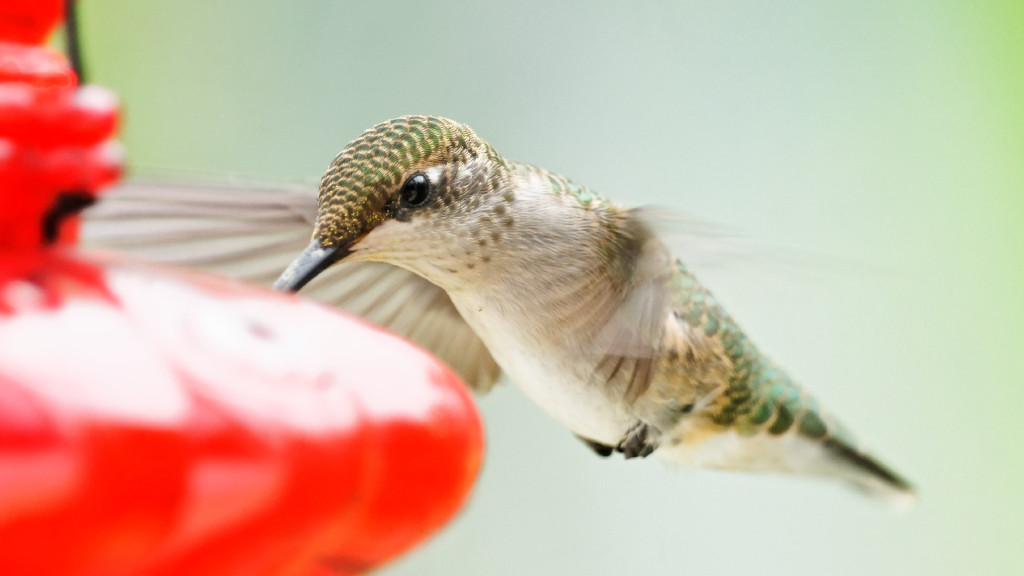
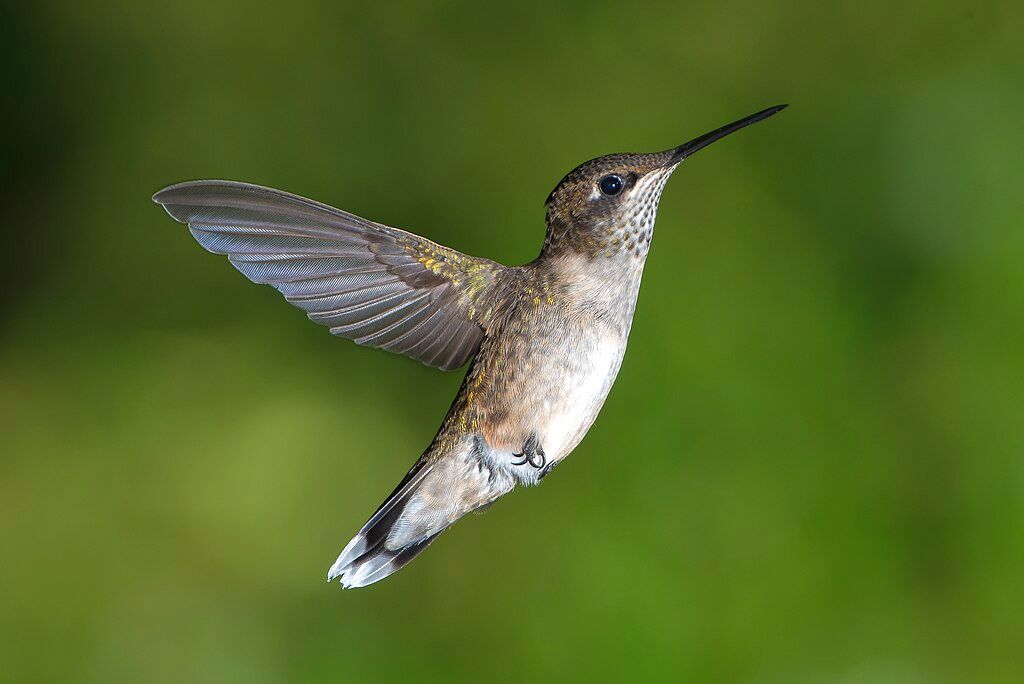
Ruby-throated hummingbird, immature male (photo from Wikimedia Commons)

24 July 2025

If you’re missing hummingbirds at your feeders this year don’t despair. The best eight weeks for ruby-throated hummingbird (Archilochus colubris) abundance in Pittsburgh has just begun. Juvenile hummingbirds are fledging and migrants will arrive soon to swell the population.

Each brood of ruby-throated hummingbird babies consumes about 9-10 weeks of the female’s time. Beginning with her arrival in Pittsburgh in late April she engages in …

  • Nest building for 6-10 days
  • Egg laying: 2 eggs laid 1-3 days apart
  • Incubation for 12-14 days
  • Hatching: Asynchronous. One of the nestlings is oldest.
  • Nestling phase for 18-22 days until each one fledges.
  • Fledglings fed by mother: 4-7 days
Female ruby-throated hummingbird with nesting material at her nest (photo from Wikimedia Commons)

Egg dates in Pennsylvania range from 9 May to 28 August. There’s enough time to raise two broods.

By late July the first broods are on their own and visiting your feeders. The presence of these juveniles nearly doubles the local population.

Ruby-throated hummingbird, Annandale, NJ, 5 Sept 2012 (photo by Ellen & Tony via Flickr Creative Commons license)

Late next week the first migrating hummingbirds will arrive and further increase the population. You can see them ebb and flow in this animation from eBird Status and Trends.

Ruby-throated hummingbird weekly abundance in North and Central America (animation from eBird Status and Trends)

The Best 8 Weeks has begun! Watch them this summer. They’ll all be gone by the end of September.

Elusive Celebrity Warbler Visits Pittsburgh

Connecticut warbler at Bellevue Memorial Park, 24 May 2025 (photo by Steve Gosser)

25 May 2025

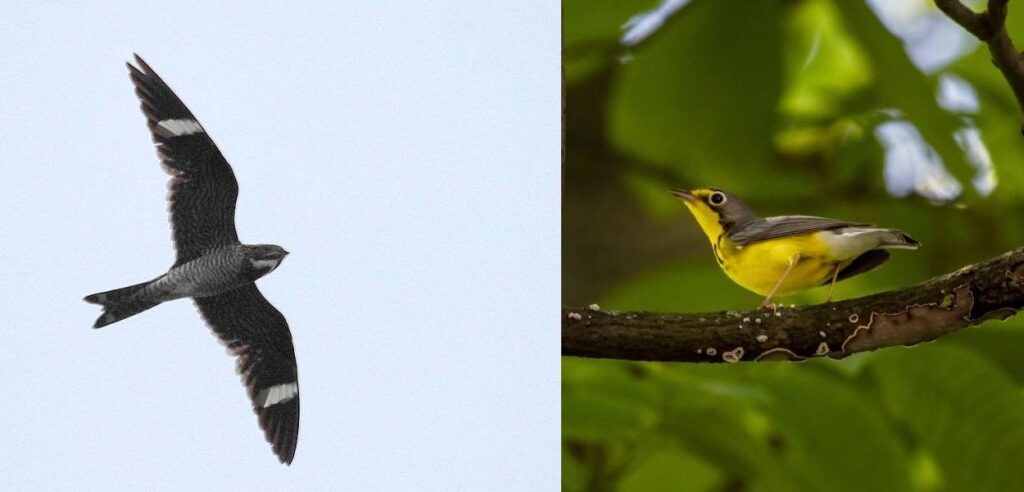
On 18 May Chris Lituma reported a Connecticut warbler (Oporornis agilis) at Bellevue Memorial Park. By the end of the week Steve Gosser and I were two of about 100 people who looked for the bird. Many of us went twice. I did.

So a Connecticut Warbler has been hanging at Bellevue Park for nearly a week now. Not only are these warblers not common but they are true skulkers that usually stay hidden. I went over a few nights ago and got to hear him sing but no luck with photos. This evening I went back over and I finally got him after waiting nearly 2 hours for him to pop up. Looking back at my archives, the last one I saw and got pics was back in Sept 2016, nearly 9 years ago! Yes this is a very special bird and so thrilled I got some photos.

Steve Gosser on Facebook, 24 May 2025

A hundred Pittsburgh birders showed up for this warbler because he is rare and very hard to find. Crowd sizes varied. This is the midday crowd on Friday.

Birders looking for the Connecticut warbler at Bellevue Memorial Park, 24 May 2025 (photo by Charity Kheshgi)

Why so many people and why did we come more than once?

Connecticut warblers are skulkers that slowly poke around out of sight in the underbrush and thickets. The male’s song is quite loud and he throws his head back when he sings so the sound bounces off the low canopy.

He’s impossible to find if he’s not singing so if you showed up at 1:00pm on Wednesday, as I did, and the bird is silent and you only have half an hour to wait for him to sing. … Well you’ll have to come back later.

When I returned on Thursday he was singing but it still took an hour to see him. First looks are usually poor but rewarding. Charity Kheshgi visited several times to get a good photograph. Notice how the views improved.

My best view was this one, captured by Ryder Shelley who was standing next to me on Thursday.

And this view is why everyone comes back, over and over again. It takes a lot of luck to see a Connecticut warbler this well. Phillip Rogers was very, very lucky.

As of 7:50am today (25 May) the warbler is still in Bellevue Memorial Park. Someone heard him this morning and is hoping to see him.

Sooner or later the bird will leave for his breeding grounds up north but we won’t know he’s gone until people try for at least a day with no luck.

UPDATE on Tuesday 27 May 2025: The Connecticut warbler is gone. No one has reported it since the afternoon / evening of Sunday 25 May.

Unexpected Item on Pitt Peregrines’ Menu

Male chick from Pitt peregrine nest on Banding Day, 21 May 2025 (photo by Kate St. John)

24 May 2025

On Thursday I wrote about the Pitt peregrine banding on 21 May — see story & photos here — but I did not include a photo of the unusual prey item Patti Barber found at the nest. It was the skull of an American woodcock (Scolopax minor), a “timberdoodle.”

I have never seen a woodcock in the city and certainly not in Schenley, the nearest park to Pitt’s campus. Schenley’s habitat is not suitable for woodcocks but they do court, and therefore breed, at North Park’s Upper Field.

American woodcock among fallen leaves (photo from Wikimedia Commons)

In spring and fall American woodcocks migrate at night, passing over the City of Pittsburgh on their way.

I imagine this one was flying above the Cathedral of Learning one night when the peregrines saw it lit by the building lights and flew up to get it. Yes, peregrines do hunt at night if there’s abundant prey and enough light to see it.

Prey item from Pitt peregrine nest: American woodcock collected on Banding Day 21 May 2025 (photo by Kate St. John)

At study published in 2006 documented peregrines hunting at night at the Empire State Building and in 2019 Jeffrey Ward took a video of one hunting in the 911 Tribute Lights in New York City. See the details at the links below:

So what about this unexpected prey item?

The Cathedral of Learning is lit on the nights after sports victories by Victory Lights similar to the 911 Tribute Lights. In October 2018 I wrote about the Victory Lights’ deadly attraction for migrating birds and within two weeks Pitt had a plan to cycle the lights every hour to break to spell they cast on migrating birds.

If this woodcock was attracted to the Victory lights the lights would have cycled and released him within the hour. But with three hungry mouths to feed, the peregrines didn’t wait that long. 🙂

First Monarch Butterflies Have Arrived in PA

Male monarch butterfly, 2008 (photo by Marcy Cunkelman)

14 May 2025

Monarch butterflies (Danaus plexippus) are migrating north and, happily, the first few have arrived in Pennsylvania within the past two weeks.

As of this morning there are 11 monarch butterfly sightings on Journey North’s 2025 spring migration map. Here are six of the 11 including the very first one on 30 April in Philadelphia.

  • Philadelphia, Philadelphia County, 4/30/2025
  • Pittsburgh, Allegheny County, 5/5/2025
  • McKees Rocks, Allegheny County, 5/10/2025
  • Pennsylvania Furnace, Centre County, 5/10/2025
  • Gettysburg, Adams County, 5/11/2025
  • York, York County, 5/12/2025

These sightings were gleaned from the Journey North Monarch (Adult) First Sighting map, shown below in a screenshot frozen in time on 14 May 2025.

screenshot of Journey North Monarch (Adult) First Sighting map as of 14 May 2025

Ideally we’ll see a handful more monarchs this year compared to last because …

In March the World Wildlife Fund reported that December 2024’s count of eastern monarch butterflies wintering in Mexico showed the eastern population had nearly doubled since the prior year. This is good news in the very short term but is tempered by a sober look at World Wildlife Fund’s Annual Count graph, embedded below. (Purposely small so that you click here to see the full size graph at WWF.)

The graph shows healthy large populations from 1993-1994 through 2003-2004, then acreage drops off to the worst year of only 1.66 acres (in red) in 2013-2014.

This year’s 4.42 acres (2024-2025) is nearly twice last year’s 2.22 but both are still among the five lowest levels in 32 years. There’s a lot of work to do both here and in Mexico to continue the monarchs’ turnaround. (*)
Meanwhile, watch monarch butterfly migration at the Journey North 2025 monarch map. Click the Play button on the map’s control panel (screenshot below) to see their progress.

Report the ones you see to put them on the map.

(*)For information on the monarchs’ plight see July 2024’s blog: Have You Seen Any Monarchs This Year? and Christine Rickabaugh’s comment about the situation in Mexico.)